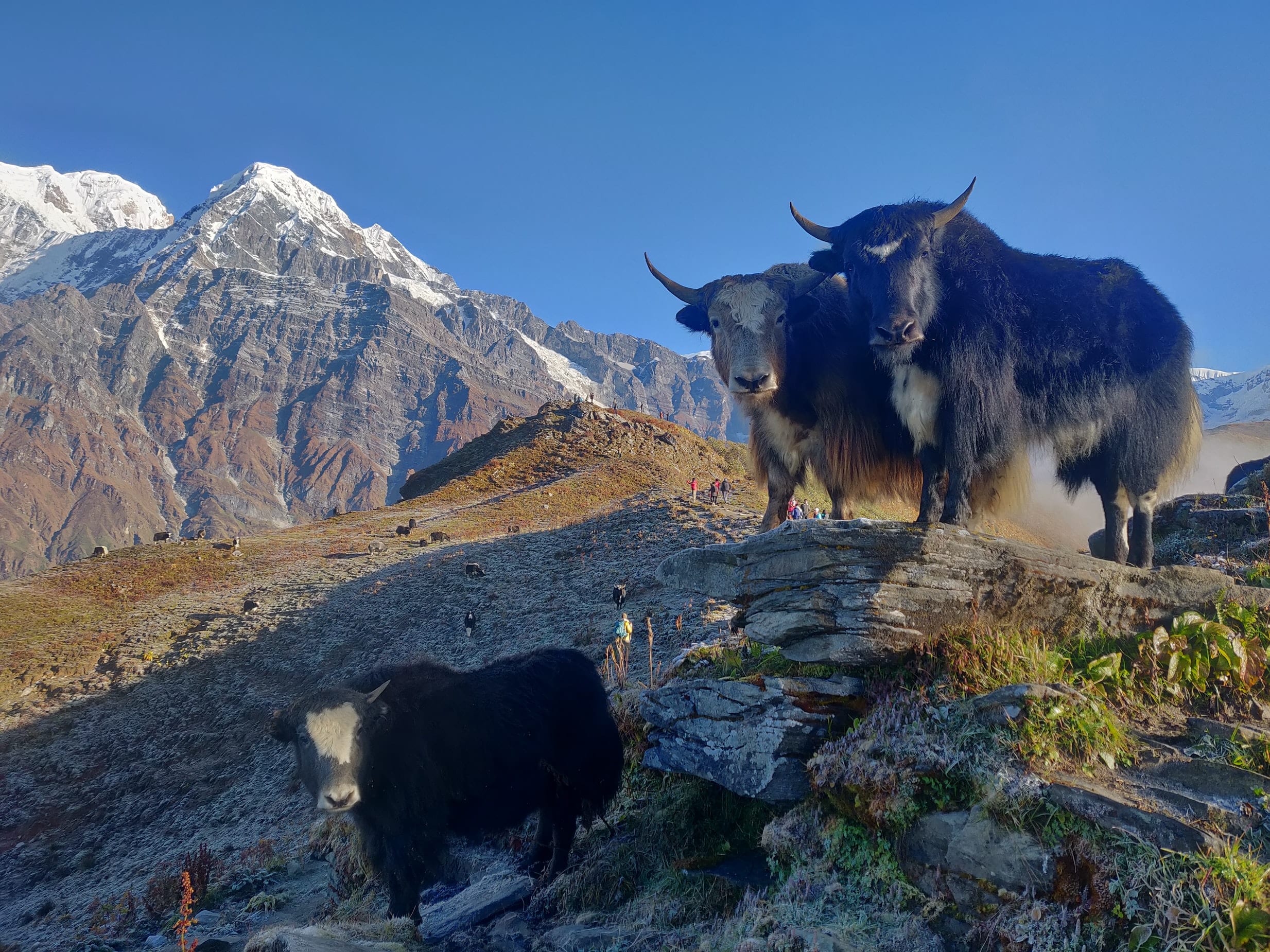
Yaks are long-haired cattle from the high mountains of Central Asia, where they have lived alongside people for thousands of years. They grunt instead of mooing, shrug off bitter cold and give herders milk, wool, transport and even fuel. Here are 18 facts about yaks.
1There are wild yaks and domestic yaks.
The wild yak (Bos mutus) lives mainly in northern Tibet and western Qinghai in China, with smaller numbers in Xinjiang and Ladakh in India. The domestic yak (Bos grunniens) is kept across the Himalayas, the Tibetan Plateau, the Pamir Mountains and as far north as Mongolia and Siberia.

2Yaks grunt instead of mooing.
Yaks do not make the lowing sound of farm cattle. Both wild and domestic yaks grunt and squeak, which is why the domestic yak’s scientific name, grunniens, means “grunting”.
3The wild yak was once thought to be silent.
The Russian explorer Nikolai Przhevalsky believed the wild yak made no sound at all, so it was named Bos mutus, the “mute ox”. In fact it grunts just like its domestic relative.
4Wild yak bulls are giants.
Adult wild yaks stand about 1.6 to 2 metres tall at the shoulder, and bulls can weigh around a tonne. Females are much smaller, at roughly a third of the weight of a bull. Domestic yaks are smaller still, with males weighing about 350 to 585 kg.
5They live higher than any British mountain.
Wild yaks live on treeless uplands between about 3,000 and 5,500 metres above sea level. Even the bottom of that range is more than twice the height of Ben Nevis, the UK’s highest mountain at 1,345 metres.
6Yaks can survive -40 °C.
Yaks can cope with temperatures as low as -40 °C, which is also -40 °F. A long, thick outer coat traps warm air against the body, and underneath is a fine, soft layer of downy hair that grows thicker in the cold season.
7Their bodies are built to save heat.
Yaks have a compact body, a short neck, short legs and tail, and small ears. This shape means less skin for heat to escape from. They also have a thick layer of fat under the skin.
8Yaks struggle in the heat.
Yaks are most comfortable between about 5 and 13 °C and can suffer heat exhaustion above about 15 °C, which is a mild spring day in Britain. They have almost no working sweat glands, apart from on the muzzle, so they cool down mainly by breathing faster.
9They have big lungs and special blood.
Yaks have larger lungs and hearts than lowland cattle, which helps them breathe the thin mountain air. They also keep a type of haemoglobin found in unborn calves throughout their lives, which helps their blood carry more oxygen.
10Yaks eat grass, sedges and even lichen.
Yaks are herbivores. Wild yaks mostly eat grasses and sedges, plus smaller amounts of herbs, low shrubs and mosses, and they have even been seen eating lichen.
11Females and males mostly live apart.
Wild yak herds are made up mainly of females and their young, and can contain several hundred animals, although many are much smaller. Most adult males live alone or in small groups of around six.

12A yak usually has a calf every other year.
Yaks mate in summer, and a single calf is born the following spring after a pregnancy of about nine months. Females usually have their first calf at three or four years old and then give birth only once every two years.
13Yaks can live for more than 20 years.
Domestic and captive yaks may live for more than 20 years. Wild yaks probably have somewhat shorter lives.
14People tamed yaks thousands of years ago.
A genetic study published in 2015 estimated that yaks were domesticated on the Qinghai-Tibet Plateau around 7,300 years ago, most likely by nomadic people. More than 14 million domestic yaks now live in the region.
15Nothing from a yak goes to waste.
Domestic yaks provide milk, meat and wool, and carry loads over mountain passes. Yak butter is used in butter tea and lamps, the milk becomes hard cheese such as chhurpi, and dried yak dung is burned as fuel where there are no trees.
16Yaks and cattle can have calves together.
In Nepal, Tibet and Mongolia, yaks are crossed with cattle. The male hybrid, called a dzo, cannot breed, but the female, called a dzomo, can.

17Wild yaks are a vulnerable species.
The wild yak is listed as Vulnerable by the IUCN, and a 2008 assessment suggested there were no more than 10,000 adults. Poaching is the biggest threat, along with interbreeding with domestic yaks. Their natural predators include wolves, and snow leopards and bears sometimes take young or weak animals.
18Some wild yaks are golden.
A rare golden-brown form, known in China as the wild golden yak, has an estimated population of only about 170 animals. It is treated as endangered in China.
FAQs about yaks
Is a yak a type of cow?
A yak is a member of the cattle family, but it is a separate species from the farm cow. Yaks and cattle can still interbreed.
How many wild yaks are left?
The last full estimate, from 2008, suggested no more than 10,000 adult wild yaks. Domestic yaks are far more common, with more than 14 million on the Qinghai-Tibet Plateau.
Where do yaks live?
Wild yaks live mainly on the Tibetan Plateau in China, with small numbers in Ladakh in India. Domestic yaks are kept across the Himalayas and Central Asia, from Nepal and Bhutan to Mongolia and Siberia.
Sources and further reading
- Wikipedia: Wild yak
- Wikipedia: Yak
- Nature Communications (2015): Yak whole-genome resequencing reveals domestication signatures and prehistoric population expansions
- Veterinary Sciences (2022): Possible consequences of climate change on Himalayan yak
Explore more: facts about Tibet, facts about Mount Everest and facts about Mongolia.
Do you know any fun facts about yaks? Share them in the comments below!
Spotted something wrong? Suggest a correction
We check every suggestion and update articles when facts change. Thank you for helping keep facts.uk accurate.
Leave a Reply