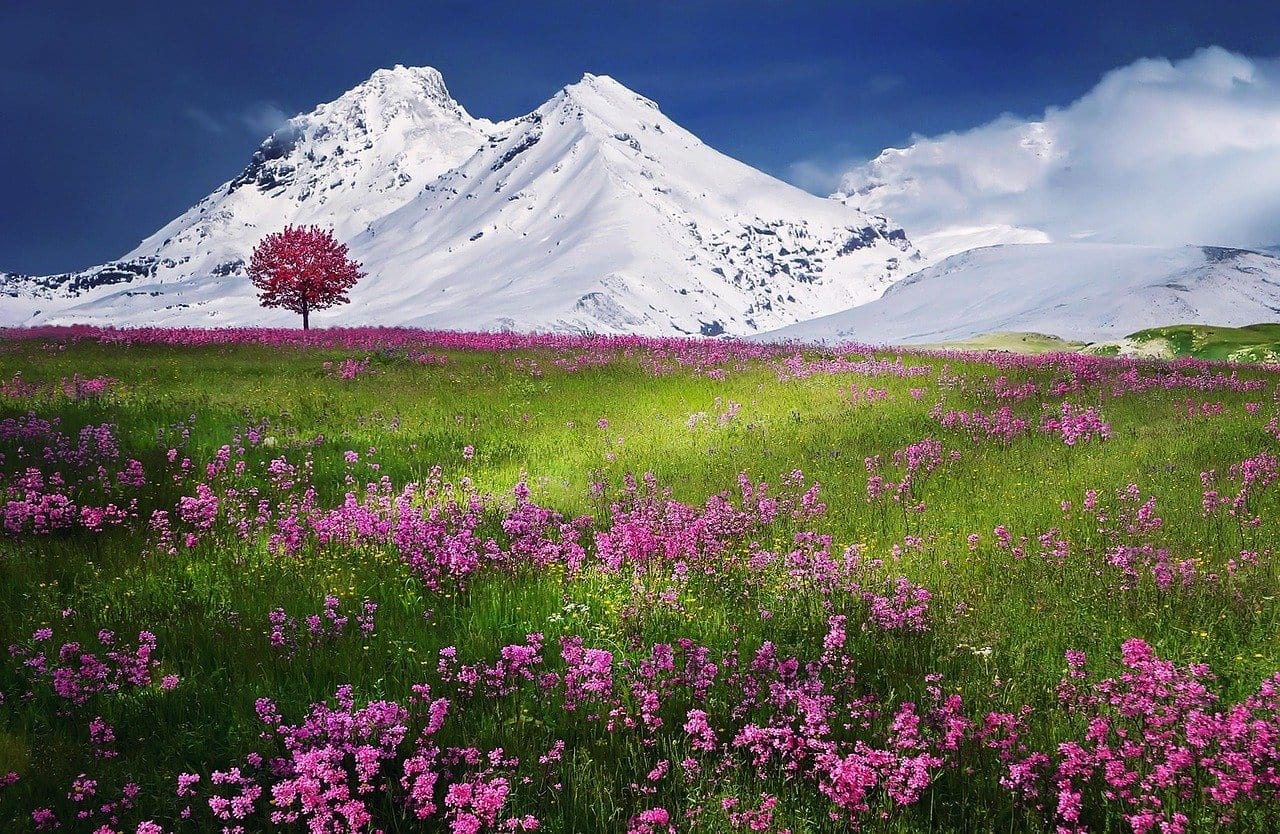
The Alps are the highest and longest mountain range entirely in Europe, a great arc of peaks, glaciers and lakes that stretches across eight countries. They have been crossed by armies, climbed by pioneers and skied by millions. Here are 15 facts about the Alps.
1They stretch for about 1,200 kilometres.
The Alps curve in a long arc from near Nice on the Mediterranean coast to near Vienna in Austria.
2They cross eight countries.
France, Monaco, Italy, Switzerland, Liechtenstein, Germany, Austria and Slovenia all have land in the Alps. Switzerland, Austria and Liechtenstein are mostly mountainous.

3Mont Blanc is the highest peak.
Mont Blanc, on the border of France and Italy, is about 4,806 metres high. Its exact height changes slightly from year to year with the thickness of the ice and snow on its summit.

4More than 80 peaks are over 4,000 metres.
The official list of the International Climbing and Mountaineering Federation includes 82 Alpine summits above 4,000 metres, and climbers try to “collect” them all.
5The Matterhorn’s first ascent ended in tragedy.
The Englishman Edward Whymper led the first climb of the Matterhorn in 1865. On the way down, a rope broke and four of the seven climbers fell to their deaths.
6The Alps were formed by a collision of continents.
The Alps were pushed up as the African plate moved north into the Eurasian plate. Most of the mountain building happened over the last 65 million years, and the Alps are still rising slowly today.
7Hannibal crossed them with elephants.
In 218 BC, the Carthaginian general Hannibal led an army with about 37 war elephants over the Alps to attack Rome. Historians still argue about which pass he used.
8A 5,300-year-old man was found in the ice.
In 1991, walkers on the border of Austria and Italy found the frozen body of a man who had died around 3300 BC. Known as Ötzi the Iceman, he is now in a museum in Bolzano, Italy, along with his clothes, axe and bow.

9They are the “water towers of Europe”.
Snow and glaciers in the Alps feed some of Europe’s great rivers, including the Rhine, the Rhône and the Po, and the Inn, which flows into the Danube.
10The longest glacier is the Aletsch.
The Great Aletsch Glacier in Switzerland is about 20 kilometres long, the longest in the Alps. Like most Alpine glaciers, it is shrinking fast as the climate warms.
11The world’s longest rail tunnel runs under them.
The Gotthard Base Tunnel in Switzerland, opened in 2016, is 57 kilometres long, making it the longest railway tunnel in the world.
12The first Winter Olympics were held there.
The first Winter Olympic Games took place in Chamonix, at the foot of Mont Blanc, in 1924. The Alps have hosted the Winter Games many times since.

13St Bernard dogs were mountain rescuers.
Monks at the hospice on the Great St Bernard Pass bred the dogs to help find travellers lost in the snow. The most famous, Barry, is said to have saved more than 40 lives in the early 1800s.
14About 14 million people live there.
The Alps are home to around 14 million people, and attract tens of millions of visitors every year for skiing in winter and walking in summer.
15The edelweiss is their best-known flower.
The white, star-shaped edelweiss grows high in the mountains and has become a symbol of the Alps. It is a protected plant in several Alpine countries.

FAQs about the Alps
What is the highest mountain in the Alps?
Mont Blanc, at about 4,806 metres, on the border of France and Italy.
Which countries are the Alps in?
France, Monaco, Italy, Switzerland, Liechtenstein, Germany, Austria and Slovenia.
How old are the Alps?
Most of the uplift that formed the Alps happened over the last 65 million years, which makes them young mountains in geological terms.
Sources and further reading
Explore more: facts about mountains and facts about the Rocky Mountains.
Do you know any fun facts about the Alps? Share them in the comments below!
Spotted something wrong? Suggest a correction
We check every suggestion and update articles when facts change. Thank you for helping keep facts.uk accurate.
Leave a Reply