
Napoleon Bonaparte rose from a modest family on Corsica to become Emperor of the French and the most feared general in Europe. His wars redrew the map of the continent, his laws still shape France today, and his story is closely tied to Britain, from Toulon to Waterloo and Plymouth. Here are 18 facts about Napoleon Bonaparte.
1He was born on Corsica, a year after it became French.
Napoleon was born in Ajaccio on Corsica on 15 August 1769. The island had been handed to France by the Republic of Genoa only the year before. His father, Carlo, was a lawyer from a family of minor Corsican nobility.

2He was born with an Italian name.
He started life as Napoleone Buonaparte, the Italian form of his name. He switched to the French spelling, Bonaparte, in 1796, the same year he married Joséphine de Beauharnais.
3He became a general at the age of 24.
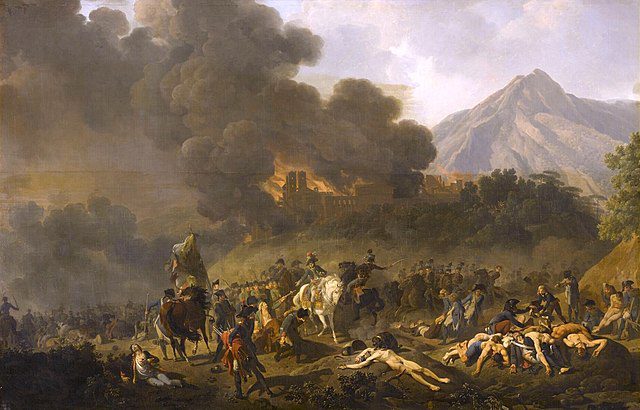
In 1793 French royalists handed the port of Toulon to a British and Spanish fleet. Captain Bonaparte organised the artillery that helped drive them out, and in December 1793 he was promoted to brigadier general, aged just 24. By 1796 he was leading the French army in Italy.
4His soldiers found the Rosetta Stone.
In 1798 Napoleon invaded Egypt. In July 1799 French soldiers digging near the town of Rosetta (Rashid) found a carved stone with the same text in three scripts. After the French in Egypt surrendered, the British took it to London, and it has been in the British Museum since 1802.
5He was not actually short.
His height was recorded as 5 feet 2 inches, but in old French units, which were longer than English ones. That works out at about 1.68 metres (around 5 feet 6 inches), roughly average for a Frenchman of his time. British cartoonists such as James Gillray helped spread the idea that he was tiny.
6He wore his famous hat sideways.
Most officers wore their two-cornered bicorne hat front to back. Napoleon wore his “en bataille”, with the corners pointing over his shoulders, so he stood out on the battlefield. He usually travelled with a set of 12 hats, and four went with him to St Helena.
7He put the crown on his own head.
Napoleon was crowned Emperor of the French at Notre-Dame in Paris on 2 December 1804. Pope Pius VII came from Rome for the ceremony, but Napoleon took the crown and placed it on his own head himself.
8Beethoven scratched his name off a symphony.
Ludwig van Beethoven admired Napoleon and planned to name his Third Symphony after him. When Napoleon made himself emperor in 1804, Beethoven scraped the words “intitolata Bonaparte” off the title page so hard that he left a hole in the paper. The symphony became known as the “Eroica”, or heroic symphony.
9His Civil Code is still the basis of French law.
The Napoleonic Code of 1804 gave France one set of laws, with equality before the law and protection for property. It still forms the core of French civil law. It was not good news for women, though: it put wives under their husbands’ authority, and most of those rules were only removed in the 20th century.

10He held the Pope prisoner for five years.
After a bitter quarrel over the Papal States, French troops arrested Pope Pius VII in Rome in July 1809. He was kept at Savona and later at Fontainebleau near Paris, and only returned to Rome in 1814 after Napoleon’s fall. The earlier Pope, Pius VI, had also died a French prisoner in 1799, but that was under the government in Paris while Napoleon was away in Egypt.
11His invasion of Russia was a disaster.
In June 1812 Napoleon led more than 600,000 men into Russia. He reached Moscow, but the city was burnt and the Russians would not make peace. On the retreat through the winter only about 100,000 of his soldiers made it back.
12He escaped from his first exile.
After defeats in 1813 and 1814, Napoleon gave up his throne in April 1814 and was sent to rule the small island of Elba, off Italy. In March 1815 he slipped away, landed in France and was back in Paris within weeks, starting the period known as the Hundred Days.
13Waterloo was his last battle.
On 18 June 1815 Napoleon was beaten at Waterloo, in what is now Belgium, by the Duke of Wellington’s army and the Prussians under Blücher. Four days later he gave up the throne for the second time.
14His favourite horse’s skeleton is in London.
Marengo, a small grey Arab horse named after Napoleon’s victory of 1800, was about 1.4 metres tall and was wounded in battle eight times. He was left behind at Waterloo and brought to England, where he died in 1831. His skeleton is on display at the National Army Museum in Chelsea.
15He surrendered to a British ship.
On 15 July 1815 Napoleon gave himself up to Captain Frederick Maitland of HMS Bellerophon. The ship anchored in Plymouth Sound, and thousands of sightseers rowed out in small boats hoping to catch a glimpse of him on deck.
16He died on a remote island in the South Atlantic.
The British sent Napoleon to St Helena, nearly 2,000 kilometres off the west coast of Africa. He died there on 5 May 1821, aged 51. Doctors who studied his autopsy report have concluded that he most likely died of stomach cancer.
17His body came back to Paris 19 years later.
In 1840 the French king Louis-Philippe arranged for Napoleon’s remains to be brought home. They arrived at Les Invalides in Paris on 15 December 1840, and today he lies in a huge tomb under its golden dome.
18His name lives on in books and pop songs.
The bossy pig who takes over the farm in George Orwell’s Animal Farm (1945) is called Napoleon. ABBA sang about his defeat in “Waterloo”, which they performed at the Brighton Dome on 6 April 1974 to win the Eurovision Song Contest.
FAQs about Napoleon Bonaparte
How did Napoleon die?
Napoleon died on St Helena on 5 May 1821, aged 51. His autopsy found a large stomach ulcer and growth, and most experts now think he died of stomach cancer. High arsenic levels in his hair led to poisoning theories, but tests show he was exposed to arsenic throughout his life, as many people were at the time.
Why is Napoleon always shown with his hand in his coat?
Painting a man with one hand tucked into his waistcoat was a common pose in the 18th century and was seen as a sign of good manners and calm leadership. It was not because of a stomach ache or an injured hand.
Where is Napoleon buried?
Napoleon is buried at Les Invalides in Paris. He was first buried on St Helena in 1821, and his remains were brought back to France in 1840.
Sources and further reading
- Fondation Napoléon: Napoleon’s hat
- Fondation Napoléon: 15 décembre 1840, le retour des Cendres (in French)
- Natural History Museum: Marengo, a warhorse’s makeover
- The Napoleon Series: Why is Napoleon’s hand in his coat?
Explore more: facts about the Battle of Waterloo, facts about the French Revolution and facts about Corsica.
Do you know any fun facts about Napoleon Bonaparte? Share them in the comments below!
Spotted something wrong? Suggest a correction
We check every suggestion and update articles when facts change. Thank you for helping keep facts.uk accurate.
Leave a Reply