North Macedonia is a small, mountainous country in the heart of the Balkans, with one of Europe’s oldest lakes, a capital rebuilt after a devastating earthquake, and a name that took nearly 30 years of argument to settle. Here are 15 facts about North Macedonia.
North Macedonia at a glance
Official name: Republic of North Macedonia
Capital: Skopje
Population: about 1.8 million (2021 census)
Area: 25,713 km² (9,928 square miles)
Languages: Macedonian and Albanian
Currency: Macedonian denar
Independence: 8 September 1991, from Yugoslavia
1It is landlocked in the Balkans.
North Macedonia has no coastline. It borders Kosovo to the northwest, Serbia to the north, Bulgaria to the east, Greece to the south and Albania to the west.
2It became independent in 1991.
North Macedonia was one of the six republics of Yugoslavia. It voted for independence in a referendum on 8 September 1991, a date now celebrated as Independence Day, and was one of the few former Yugoslav republics to leave without a war.

3Its name was disputed for almost 30 years.
Greece has its own northern region called Macedonia and objected to its neighbour using the same name. As a result, the country joined the United Nations in 1993 under the temporary name “the former Yugoslav Republic of Macedonia”.
4It became North Macedonia in 2019.
The two countries signed the Prespa Agreement beside Lake Prespa in June 2018. Under the deal, the country officially changed its name to the Republic of North Macedonia on 12 February 2019, and Greece dropped its objections to its neighbour joining NATO and the EU.
5It joined NATO in 2020.
North Macedonia became NATO’s 30th member on 27 March 2020. It has been a candidate to join the European Union since 2005, and formal membership talks opened in 2022.
6Its first flag caused a row too.
The flag adopted in 1992 showed the Vergina Sun, a 16-rayed star found on an ancient royal tomb in northern Greece. Greece objected, and in 1995 the country switched to today’s flag: a yellow sun with eight broadening rays on a red background.

7Lake Ohrid is one of the oldest lakes in Europe.
Scientists estimate that Lake Ohrid, which North Macedonia shares with Albania, is well over a million years old. It is almost 290 metres deep and home to more than 200 species found nowhere else, and it is a UNESCO World Heritage Site for both its nature and its history.
8Ohrid was once said to have 365 churches.
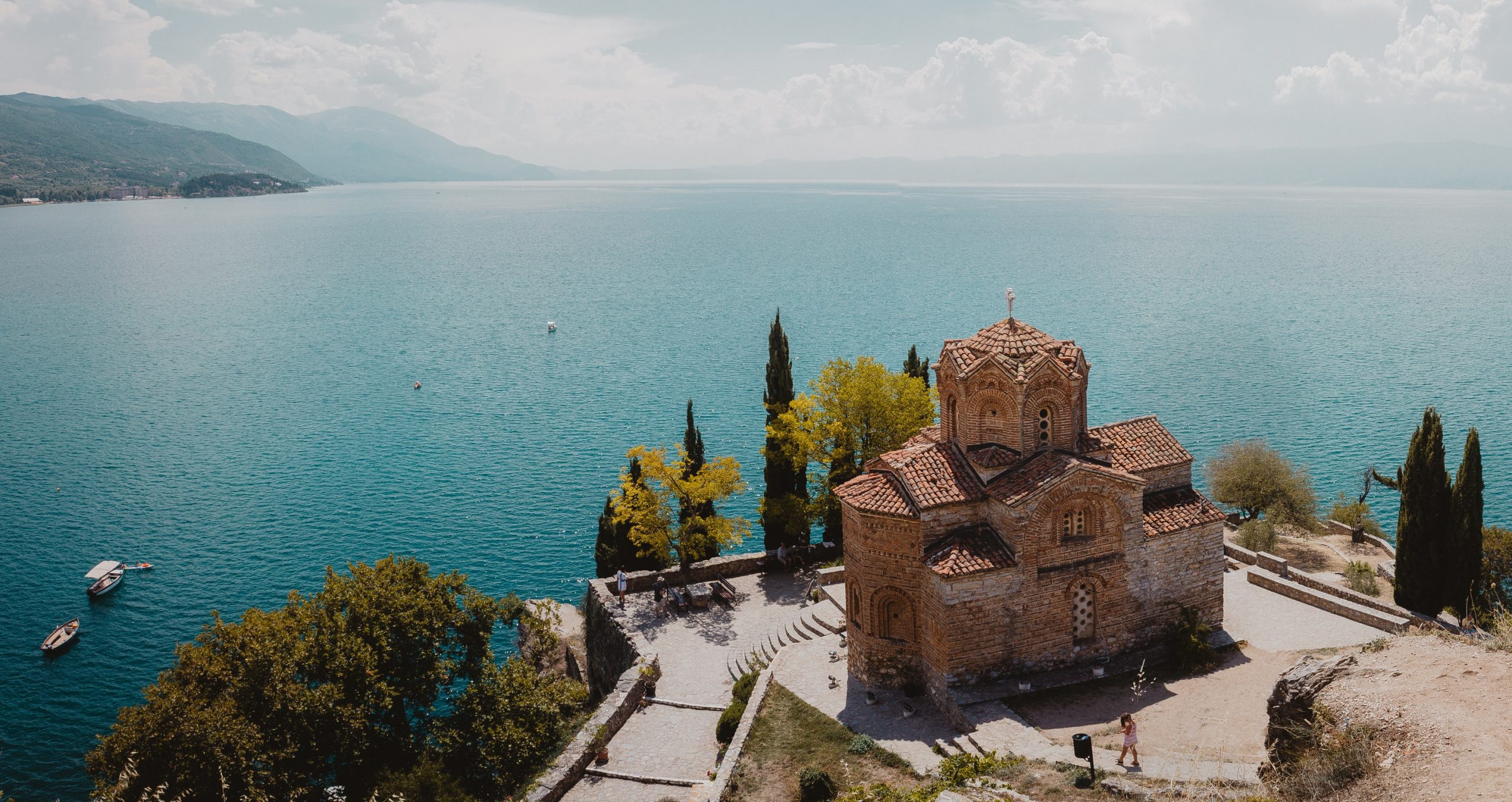
The lakeside town of Ohrid was a major centre of early Slavic Christianity and learning, and local legend says it once had a church for every day of the year. Its 13th-century Church of St John at Kaneo, perched on a cliff above the water, is one of the most photographed spots in the Balkans.
9Skopje was rebuilt after a terrible earthquake.
On 26 July 1963, an earthquake destroyed most of Skopje and killed more than 1,000 people. Countries from around the world sent help, and the Japanese architect Kenzo Tange drew up a plan for the rebuilt city centre. The old railway station clock still shows the time the earthquake struck: 5:17 in the morning.
10Mother Teresa was born in Skopje.
Anjezë Gonxhe Bojaxhiu, who became Mother Teresa, was born in Skopje on 26 August 1910, when the city was part of the Ottoman Empire. A memorial house now stands close to where she was baptised.
11Skopje is full of statues.
A building programme called “Skopje 2014” filled the centre of the capital with new monuments, fountains and classical-style buildings. The biggest is a huge statue of a warrior on horseback, widely seen as Alexander the Great, standing more than 20 metres tall with its pedestal.

12It speaks two official languages.
Macedonian, a South Slavic language written in the Cyrillic alphabet and closely related to Bulgarian, is the main language. Albanian, spoken by about a quarter of the population, is also an official language across the country.
13Its highest mountain sits on the border.
Mount Korab, at 2,764 metres (9,068 feet), is the highest point in North Macedonia and stands on the border with Albania. Around 80% of the country is hills and mountains.
14Matka Canyon is a short trip from the capital.
Just outside Skopje, Matka Canyon has steep cliffs, medieval monasteries and the Vrelo Cave, an underwater cave that divers have explored to a depth of more than 200 metres, making it one of the deepest underwater caves in Europe.
15It has a long winemaking history.
The sunny Tikveš region in the centre of the country is its main wine area. The local red grape, Vranec, makes a dark, strong wine that has become North Macedonia’s best-known export.

FAQs about North Macedonia
When did Macedonia become North Macedonia?
On 12 February 2019, after the Prespa Agreement with Greece was signed in 2018 and approved by both countries’ parliaments.
What is the capital of North Macedonia?
Skopje, which has a population of around half a million people.
Is North Macedonia in the EU?
No. It is a candidate country and has been in membership talks since 2022, and it joined NATO in 2020.
What language do they speak in North Macedonia?
Macedonian and Albanian are both official languages. Macedonian is written in the Cyrillic alphabet.
Sources and further reading
Explore more: facts about Mother Teresa.
Do you know any fun facts about North Macedonia? Share them in the comments below!
Spotted something wrong? Suggest a correction
We check every suggestion and update articles when facts change. Thank you for helping keep facts.uk accurate.
Leave a Reply