Nestled in the eastern Caribbean, Grenada is a small island country known for its stunning beaches, lush rainforests, and vibrant culture. With a population of around 117,000, it is one of the smallest independent countries in the western hemisphere. Despite its size, Grenada packs in a remarkable amount of history, geology, and culture — from an active submarine volcano lurking just off its northern coast, to a US invasion the island now commemorates as its own Thanksgiving. Let’s explore this extraordinary little nation with these 21 facts about Grenada.
1. Grenada is a bit of a cluster.
Grenada is an archipelago of one large island and six smaller ones in the southeastern Caribbean. Three of those islands are inhabited: the main island of Grenada itself, plus Carriacou and Petit Martinique to the north. Its nearest neighbours are Saint Vincent and the Grenadines to the north, Barbados to the northeast, and Trinidad and Tobago to the south. The whole chain sits at the southern end of the Lesser Antilles volcanic arc.
2. Someone else was already home.
When Christopher Columbus arrived in 1498 and named the island La Concepción, the island was already home to the Carib people, who had displaced earlier Arawak settlers centuries before. Despite Columbus’s “discovery,” Grenada was left largely uncolonised by Europeans for over 150 years. It was the French who finally established a permanent settlement in 1649, massacring much of the remaining Carib population in the process. Britain seized the island in 1762 and held it until independence in 1974.
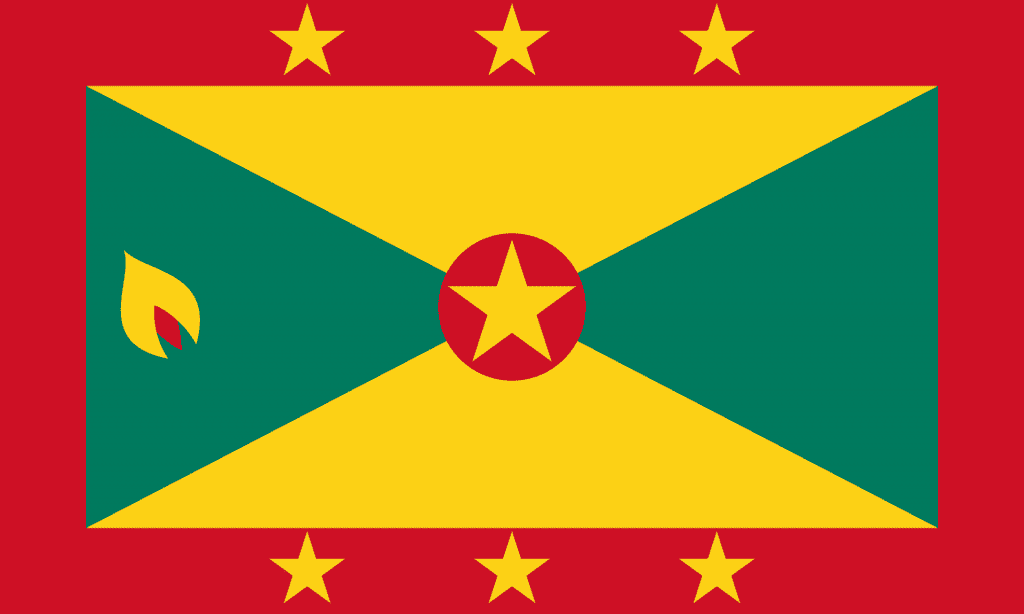
3. It’s the only national flag in the world with a nutmeg on it.
Grenada’s flag is a bold diamond of yellow and green triangles within a red border, with seven gold stars representing its seven administrative divisions. But the detail most people miss is the small yellow-and-red nutmeg pod on the left-hand green triangle. It is widely believed to be the only national flag in the world to feature a specific crop — a direct reference to Grenada’s identity as the Spice Isle. The seven stars also include one central star representing the capital, St. George’s.
4. There’s an active underwater volcano right on its doorstep.
About 8 kilometres north of Grenada lies Kick ’em Jenny — an active submarine volcano rising from the seabed. It has erupted at least 12 times since it was first recorded in 1939, and during periods of heightened activity, maritime exclusion zones are enforced around it. At its summit it sits roughly 180 metres below the surface. Scientists monitor it closely as one of the most active volcanoes in the entire Caribbean. It also gives the island chain its geological context: Grenada sits at the very southern tip of the same volcanic arc that runs all the way north to the Dutch island of Saba.
5. There’s a lot of lava here.
The terrain of Grenada is entirely volcanic in origin, with a dramatic interior of forest-covered mountains, crater lakes, and dozens of waterfalls. The highest point is Mount Saint Catherine at 840 metres. At the heart of the island sits Grand Etang, a crater lake of extraordinary depth. For decades, sonar attempts to find its bottom failed — and while it has since been mapped, locals still call it bottomless. The lush central interior is now protected as the Grand Etang National Park.
6. It’s double the size of a famous British city.
The total land area of Grenada is 133 square miles (344 square kilometres) — around twice the size of Glasgow.
7. However, it’s super sparse!
Grenada’s population is estimated at around 117,000, according to UN projections. That’s roughly one sixth of the population of Glasgow squeezed into twice the space — and around a third of the population is concentrated in and around the capital, St. George’s.
8. The capital has one of the most beautiful harbours in the Caribbean.
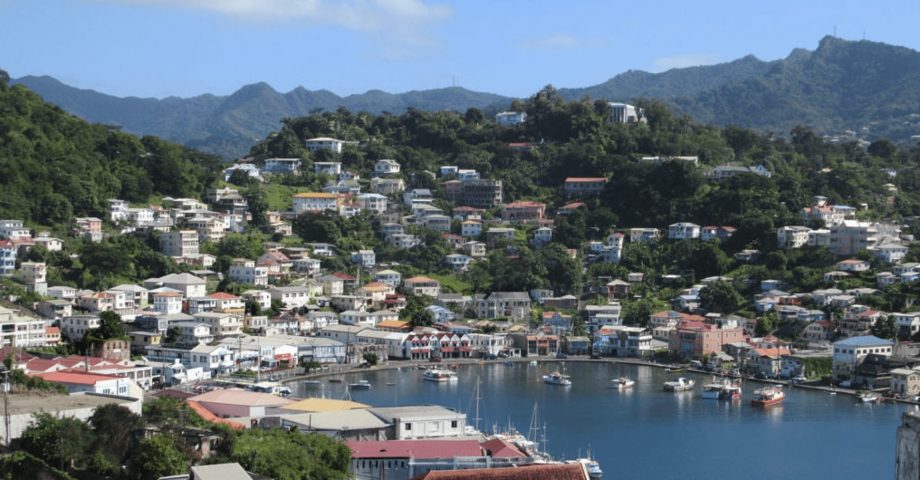
The capital is St. George’s, perched around a horseshoe-shaped inner harbour called the Carenage, lined with pastel Georgian warehouses that once stored spices for export. It is consistently rated among the most picturesque harbour towns in the Caribbean. The town was badly damaged by Hurricane Ivan in 2004 but has since been largely rebuilt.
9. The weather here is wonderful — but not without risk.
Grenadians enjoy a tropical climate with temperatures moderated by northeast trade winds. Rainfall is heaviest in the interior. Grenada sits at the southern edge of the hurricane belt, which affords it some protection — but not immunity. In September 2004, Hurricane Ivan made a near-direct hit, destroying or severely damaging an estimated 90 percent of buildings on the island. The recovery took years and cost hundreds of millions of dollars. Grenadians rebuilt almost everything you see today.
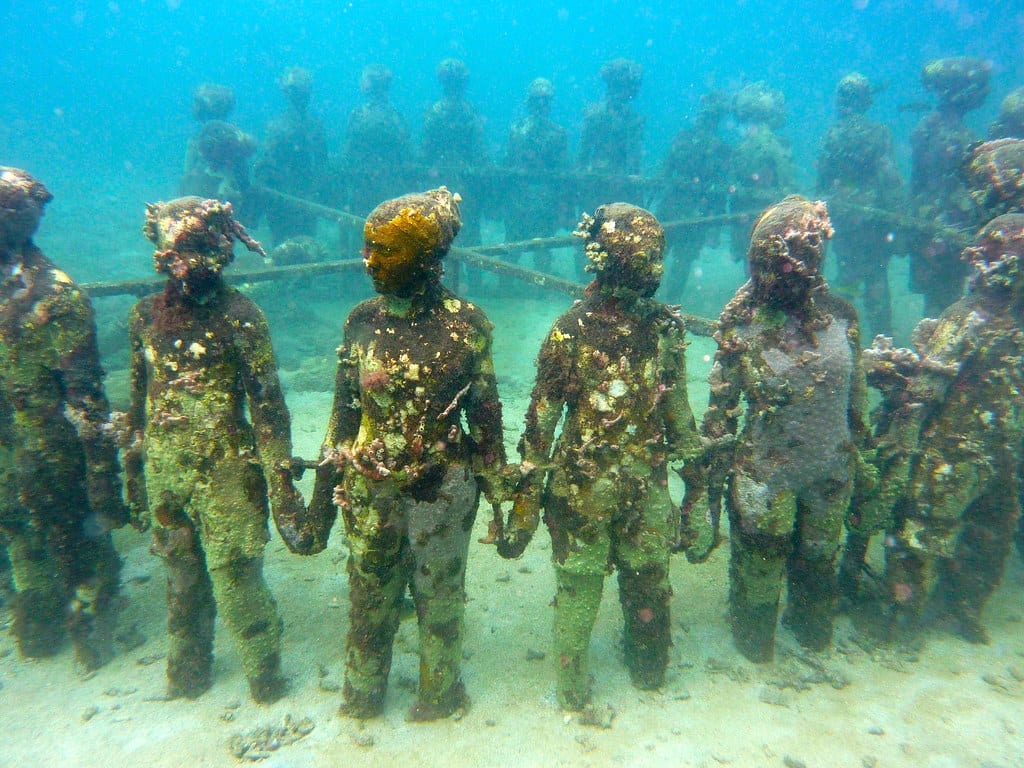
10. It has the world’s first underwater sculpture park.
Molinere Bay Underwater Sculpture Park was the first of its kind anywhere in the world when it opened in 2006. British sculptor Jason deCaires Taylor created the park in direct response to the coral damage caused by Hurricane Ivan in 2004. The 75 works cover an area of 800 square metres, submerged at depths of 5-8 metres. The sculptures are cast from pH-neutral cement, textured specifically to encourage coral polyps to attach. Over time the stark grey figures have transformed into kaleidoscopic artificial reefs hosting parrotfish, sea urchins, fire worms, and branching coral. The site is listed as one of National Geographic’s 25 Wonders of the World. The park was expanded in 2023, welcoming 27 new artworks. Accessible by scuba, snorkel, or glass-bottom boat, it is one of the most unique dive experiences in the Caribbean.
11. It’s very popular with green tourists.
Thanks to the luscious rainforests and beautiful waterfalls, Grenada experiences a lot of eco-tourism. If you’re visiting Grenada, check out the Spice Isle Field Guide — can you complete the checklist?
12. What language do people speak in Grenada?
The official language of Grenada is English, though many Grenadians also speak Grenadian Creole English — a language shaped by the island’s history of French and British colonisation, as well as the languages of enslaved West Africans brought to work the sugar estates. A French-derived Creole (Patois) is also still spoken on Carriacou. You’ll find this linguistic layering reflected in place names across the island: many are French in origin despite British rule for over two centuries.
13. It just celebrated 50 years of independence.
Grenada gained independence from Britain on 7 February 1974, making 2024 its 50th anniversary. The road to independence was turbulent: in 1979, a Marxist group called the New Jewel Movement overthrew the government of Prime Minister Eric Gairy and installed Maurice Bishop as leader. Bishop’s charismatic rule brought free healthcare, improved literacy, and closer ties to Cuba — but also ended in his execution by a hard-line faction of his own movement in October 1983, an event that triggered the US invasion just days later.
14. It’s the ‘Spice Island’ — and once ruled global nutmeg production.
Grenada is often called the Island of Spice for good reason: it produces nutmeg, mace, cinnamon, cloves, ginger, and turmeric. Nutmeg is by far the most important crop, representing both a major export and a cultural symbol — hence its place on the flag. Before Hurricane Ivan devastated the nutmeg plantations in 2004, Grenada was the world’s second largest producer of nutmeg after Indonesia. The industry has slowly recovered since. Note that nutmeg trees take up to 20 years to reach full production, which gives some sense of how generational the recovery has been.
15. What should you change your money to here?
The East Caribbean Dollar (XCD) is the official currency. It is shared with seven other Eastern Caribbean nations and has been pegged to the US dollar at a fixed rate of EC$2.70 to US$1 since 1976 — one of the longest-running currency pegs in the world. US dollars are widely accepted across the island, particularly in tourist areas.
16. Want to try the local cuisine here?
The national dish is Oil Down — a slow-cooked stew of salted meat, breadfruit, dumplings, callaloo, and whatever vegetables are to hand, simmered down in rich coconut milk seasoned with turmeric, local herbs, and the ubiquitous Grenadian spices. The name comes from the cooking technique: you add coconut milk and simmer everything until the oil from the milk “downs” into the pot, leaving the ingredients coated rather than soupy. It’s a communal dish, traditionally made in a large pot and shared at gatherings.
17. Better check your wardrobe…
Wearing camouflage clothing is illegal in Grenada for civilians. The restriction applies to any camouflage-patterned item — clothing, bags, and accessories — as the pattern is reserved exclusively for military personnel. Tourists can and do get stopped at the airport if they’re wearing camo. It’s an unusual rule, but one enforced across several Caribbean and South American nations with similar legislation.
18. It celebrates the US invasion as its own Thanksgiving.
On 19 October 1983, hard-liners within the New Jewel Movement placed Prime Minister Maurice Bishop under house arrest and then executed him along with several cabinet members. Within days, President Ronald Reagan authorised Operation Urgent Fury — citing the safety of US medical students on the island and a Cuban-backed airport construction project. US and Caribbean forces landed on 25 October 1983 and overthrew the military government within a week. What makes this story unusual is Grenada’s response to it: Grenadians celebrate the US military’s arrival as their Thanksgiving Day, a public holiday observed on 25 October each year. A Garden of Remembrance was built to honour the American soldiers killed during the operation.
19. Life expectancy here is pretty healthy.
The average life expectancy in Grenada is approximately 75 years, broadly in line with other Caribbean nations and notably higher than many countries of similar income levels. Grenada has universal public healthcare managed through the Ministry of Health, and around 98 percent of the population has access to clean drinking water. The country also received a vaccination award from the Pan American Health Organization for the quality of its immunisation programmes.
20. Traffic signals aren’t an issue here.
Bored of waiting at traffic lights? In Grenada there are just four sets of traffic lights on the entire island (as of 2024). The road network is steep, winding, and mostly single-lane once you leave the west coast highway — a 4×4 is genuinely useful for exploring the interior. Looking for a new or used SUV to drive around the island? Check out IslandMotors.com.
21. The Grenadian export scene is pretty wild — and goes deeper than spices.
Grenada’s agricultural exports include nutmeg, mace, cinnamon, ginger, cloves, cocoa, bananas, and sugarcane. Remarkably, the island is home to all three varieties of cacao grown in the world, making it one of the few places on earth capable of producing a full-spectrum artisan chocolate. Rum, fresh fish, and light manufactured goods round out the export picture. Tourism is by far the largest foreign exchange earner. And beneath the waters: the Bianca C, a 600-foot Italian cruise liner that sank in 1961 after an engine room explosion, rests at 165 feet off St. George’s and is widely regarded as one of the finest wreck dives in the Caribbean — sometimes called the Titanic of the Caribbean.
FAQs about Grenada
Is Grenada expensive?
Believe it or not, the cost of living, visiting and entertaining yourself is likely cheaper in Grenada than you may expect in the US or the UK.
What is Grenada best known for?
Also known as the Spice Island, Grenada is best known for the many spices it produces - famously cloves, nutmeg, mace and cinnamon. Its flag is believed to be the only national flag in the world to feature a specific crop: a nutmeg pod.
Is it safe to visit Grenada?
Grenada is one of the safer islands in the West Indies. Tourists should still avoid visiting isolated areas alone, and are advised not to walk on beaches after dark.
Do you know any fun facts about Grenada? Share them in the comments below!