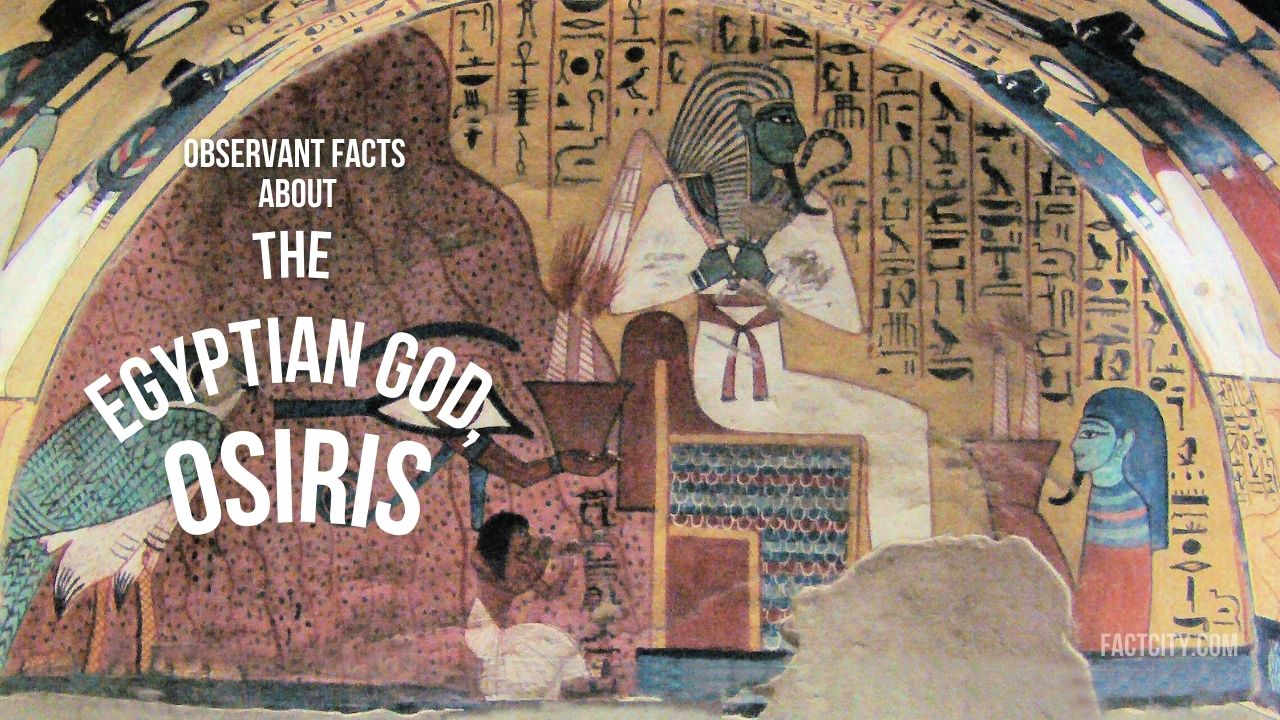
Osiris was the ancient Egyptian god of the afterlife, death and resurrection – and one of the most important deities in all of Egyptian mythology. The Egyptians believed he ruled the underworld and judged the souls of the dead, deciding who was worthy of eternal life. He’s usually shown as a mummified king with green skin, holding the crook and flail of kingship.
But Osiris is best remembered for his story – a tale of betrayal, murder, resurrection and revenge that became the most elaborate and influential myth ancient Egypt ever produced. He was killed by his own brother, lovingly pieced back together by his wife Isis, and reborn as lord of the dead. Here are 18 fascinating facts about Osiris, the Egyptian god of the afterlife.
1Osiris was one of Egypt’s most important gods.
Osiris was among the most revered and widely worshipped deities in ancient Egyptian religion. As the god who promised life beyond death, he sat at the very heart of how Egyptians understood their own mortality – which is a big part of why his worship lasted for thousands of years.
2He ruled the afterlife – but he was more than a “death god.”
Osiris is best known as god of the afterlife and the underworld, but his portfolio was broader than that. He was also a god of resurrection, fertility and vegetation. To the Egyptians, death wasn’t an ending so much as a transformation – and Osiris embodied that hope, which surely gave many people comfort.
3You can recognise him by his crown, crook and flail.
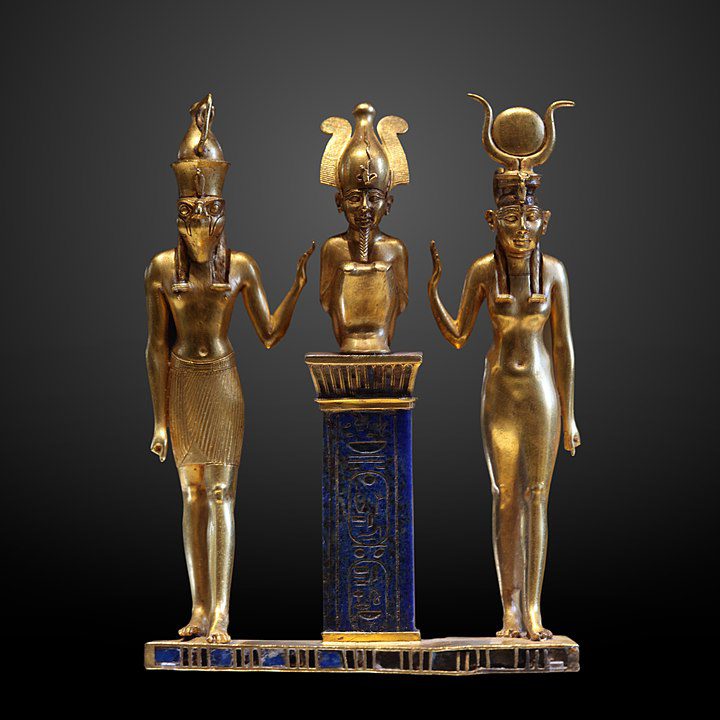
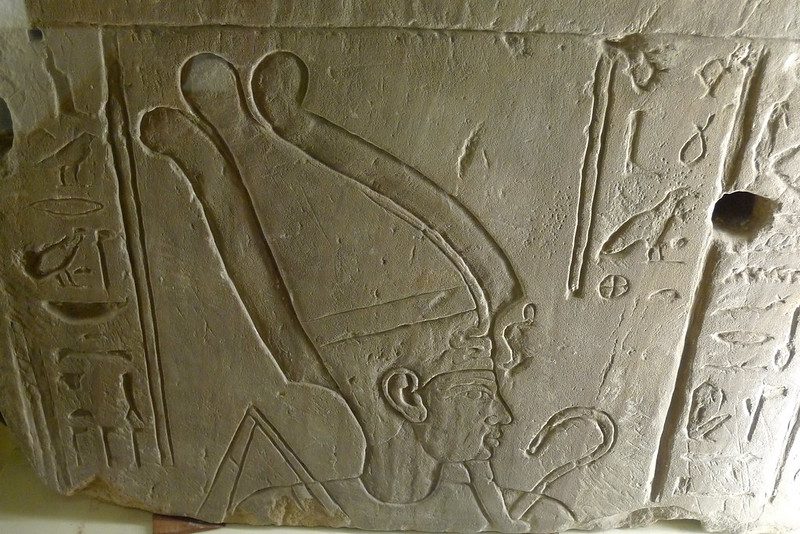
Osiris is almost always shown as a mummified king wearing the Atef crown – the tall white crown of Upper Egypt flanked by a pair of ostrich feathers – and holding the crook and flail, ancient symbols of kingship.
4His green skin isn’t an accident.
Osiris is often depicted with green – or sometimes black – skin, and both colours carry meaning. Green symbolised rebirth, new growth and vegetation, while black represented the rich, fertile silt left behind by the Nile’s floods. Either way, the message was the same: life returning from death.
5He came from a famous family of gods.
Osiris was the son of Geb, god of the earth, and Nut, goddess of the sky. His siblings were just as significant: his sister and wife Isis, goddess of magic and motherhood, along with Set and Nephthys. It was one of the most important divine families in the whole of Egyptian mythology.
6He was murdered by his own brother.
In the myth, Osiris was killed by his jealous brother Set (also spelled Seth), who resented his power and his throne. Set tricked Osiris into climbing inside a beautiful chest – tailor-made to fit him exactly – then sealed it shut and cast it into the Nile. Fratricide, Egyptian style.
7Set didn’t stop there – he scattered the body.
When Isis recovered the chest, Set seized the body and cut it into pieces – fourteen of them, in the best-known version of the tale – scattering them the length of Egypt so his brother could never be made whole again. It’s one of mythology’s grislier crimes.
8Isis pieced him back together.
Refusing to give up, Isis journeyed across the land and gathered the scattered fragments of her husband, binding them back together. She recovered every part but one – his phallus, which (in the Greek writer Plutarch’s retelling) had been swallowed by a fish – so she fashioned a replacement. This act of reassembly is why Osiris is linked to the very first mummy.
9He fathered Horus after his own death.
Using her powerful magic, Isis briefly revived Osiris – long enough to conceive their son, Horus. Often shown as a falcon, Horus grew up to avenge his father, doing battle with Set to reclaim the throne. Few gods manage to become a father after being murdered and dismembered.
10After death, Osiris became king of the underworld.
Rather than simply passing away, Osiris took on a new and greater role: ruler of the Duat (the underworld) and judge of the dead. Death, fittingly, was less an end for him than a promotion.
11He presided over the famous “weighing of the heart.”
In the Egyptian vision of judgment, a dead person’s heart was weighed on a scale against the feather of Maat, goddess of truth and justice, before Osiris and a tribunal of 42 divine judges. If the heart was light and pure, the soul earned eternal life. If it was heavy with wrongdoing, it was devoured by the monstrous Ammit – and the person ceased to exist entirely.
12Osiris was the model for mummification itself.
Because Isis wrapped and reassembled his body to restore him to life, Osiris became the mythological blueprint for mummification. Every Egyptian who was mummified was, in a sense, hoping to follow his path from death into the afterlife.
13Ordinary Egyptians hoped to “become” Osiris.
At first, only the pharaoh was thought to merge with Osiris after death. Over time this hope spread to everyone: the deceased were referred to as “the Osiris” followed by their own name, identifying them with the god and his promise of resurrection. It was, in effect, the democratisation of the afterlife.
14His story mirrored the flooding of the Nile.
The annual flooding of the Nile, which brought fertile soil and new crops, was closely tied to the Osiris myth. His death and rebirth echoed the yearly cycle of the land dying back and returning to life. Egyptians even made “Osiris beds” – seed sown into soil shaped like the god, left to sprout as a living symbol of his resurrection.

15The “Djed” pillar was said to be his backbone.
One of ancient Egypt’s most common symbols, the djed – a pillar with four crossbars – was understood as the backbone of Osiris. Worn as an amulet, it represented stability, endurance and resurrection, and “raising the djed” was a ritual tied to his renewal.
16Abydos was his holy city.
The city of Abydos was the great centre of Osiris worship and believed by many to be his burial place. Each year, elaborate “passion plays” were staged there, re-enacting his death, mourning and resurrection before crowds of pilgrims – some of the earliest recorded religious drama in history.
17His son Horus took a throne of his own.
The long conflict between Horus and Set over Osiris’s crown is one of the central sagas of Egyptian myth. In the end, Horus won kingship over the land of the living, while Osiris ruled the dead – neatly dividing the cosmos between father and son.
18He was worshipped for millennia – and evolved into Serapis.
Osiris’s cult endured for thousands of years and reached across all of Egyptian society. Later, under the Greek-speaking Ptolemies, his worship blended with Greek religion to create a new composite god, Serapis – proof of just how enduring his appeal was.
FAQs About The Egyptian God Osiris
Who was the Egyptian god Osiris?
Osiris was the ancient Egyptian god of the afterlife, death and resurrection, and the ruler and judge of the underworld. According to myth he was a king who was murdered by his brother Set, restored by his wife Isis, and reborn as lord of the dead – deciding which souls earned eternal life. He is usually shown as a green-skinned mummified king holding the crook and flail.
Is Osiris good or bad?
Osiris was seen as a benevolent and just god – one reason he was so widely worshipped. Though he was associated with death, he was a positive figure who was believed to help worthy souls cross safely into the afterlife and gain eternal life.
Who was Osiris in love with?
Osiris loved his sister and wife, Isis – goddess of magic, motherhood, fertility and healing. According to the Greek writer Plutarch, the two were so devoted that they were said to have loved each other even before birth, in the womb of their mother Nut.
Was Osiris more powerful than Isis?
In many myths Isis is portrayed as extraordinarily powerful – it was her magic that reassembled and revived Osiris, and in one famous story she even tricked the sun god Ra into revealing his secret name to gain power over him. So while Osiris ruled the afterlife, Isis’s magic was often shown as unmatched, even by her husband.
Further reading
More facts about Ancient Egypt
Osiris – World History Encyclopedia
Osiris – Wikipedia
Do you know any fun facts about the Egyptian god Osiris? Share them in the comments below!
Spotted something wrong? Suggest a correction
We check every suggestion and update articles when facts change. Thank you for helping keep facts.uk accurate.
Leave a Reply