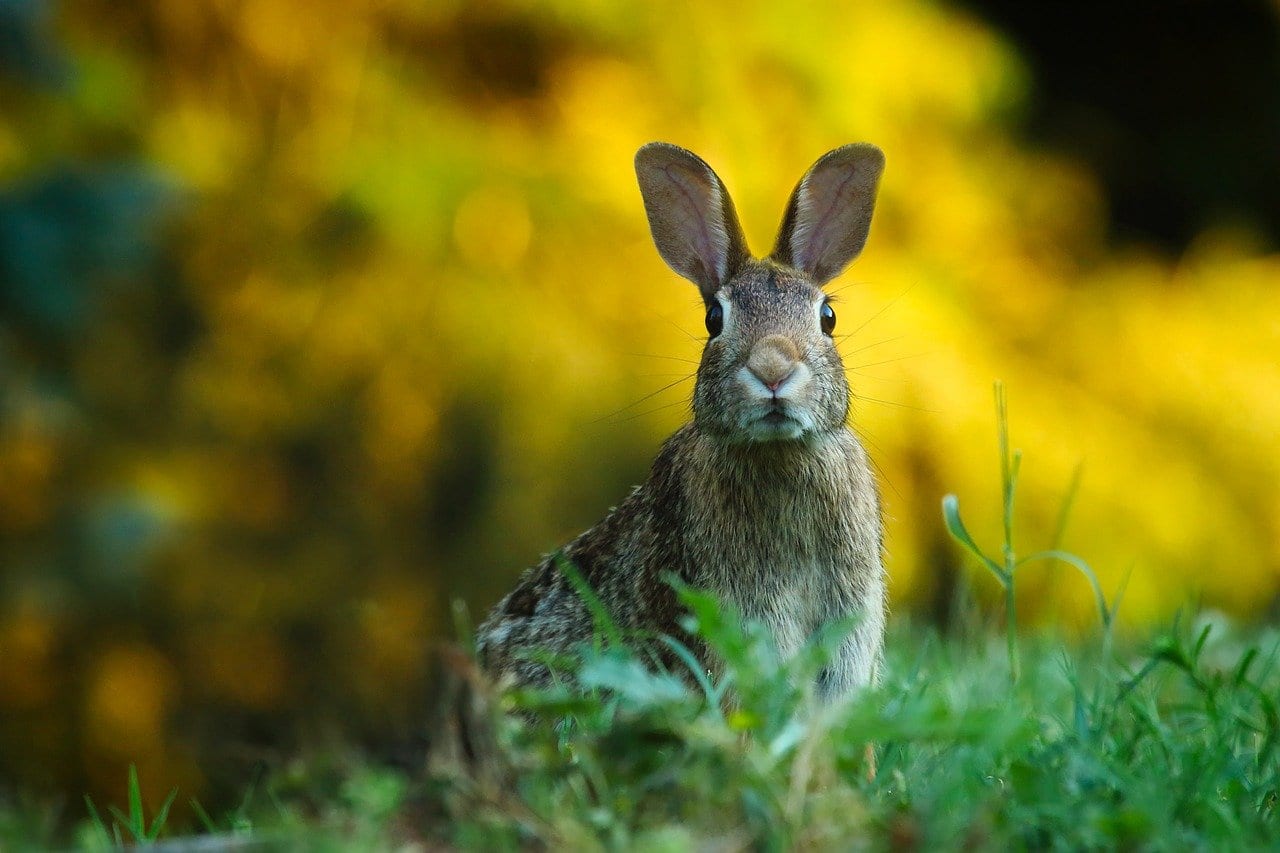
Rabbits are small mammals with cute fluffy, short tails, whiskers, and distinctive long ears. Around the world, there are nearly 50 different species, and while they live in many diverse environments, they have many things in common. Let’s find out more about these furry little creatures through these 32 fun facts about rabbits…
1Are rabbits and hares related?
Leporidae is the taxonomic family of rabbits and hares.
Within the family, there are 11 genera, but the term “true hares” refers only to species in the genus Lepus, all the others are rabbits.
2There are more rabbit breeds than cat breeds.
The American Rabbit Breeders Association (ARBA) recognises 49 rabbit breeds.
3Rabbits really vary in terms of size.
Some rabbits are about the size of a cat, and some can grow to be as big as a small child.

4The tiny ones are minute – the big ones are huge!
Small rabbits, such as pygmy rabbits, can be 8 inches (20 cm) in length and weigh less than a pound. Larger species grow to 20 inches (50 cm) and more than 10 lbs. (4.5 kg).
5There are record-breaking rabbits!
According to Guinness World Records, the world’s longest rabbit is a Flemish giant, 4 feet 3 inches (129 cm) in length and 49 pounds (22 kg) in weight.
6What are the smallest breeds of rabbit?
Britannia Petite, Netherland Dwarf, Dwarf Hotot, and the Himalayan are small rabbit breeds.
7Rabbits breed a lot for a reason.
Rabbits are well-known for their ravenous reproductive habits. Rabbits breed 3 to 4 times each year.
Because only 15% of baby rabbits make it to their first birthday, to make sure that the population grows, rabbits have more babies.
8Young rabbits share the same name as young cats.
Each pregnancy produces 3-8 babies, called kittens or kits.
9Rabbits can’t see, at least initially.
Rabbits are born with their eyes shut.

10Rabbits are amazingly self-sufficient.
After 4 to 5 weeks, a kit can care for itself. In 2 or 3 months it is ready to start a family of its own.
11Rabbits thrive without risk.
An area can quickly become overrun with rabbits if there is a lack of natural predators.
12Rabbits love greenery.
Rabbits are herbivores, meaning that they have a plant-based diet and they don’t eat meat.
They eat grass, clover, and some cruciferous plants, such as broccoli and Brussels sprouts. Rabbits also eat fruits, seeds, roots, buds, and tree bark.

13Rabbits can be found pretty much everywhere.
Even though rabbits originate from Europe and Africa, they are now found all over the world.
They inhabit most of the world’s landmasses, excluding southern South America, the West Indies, Madagascar, and most islands southeast of Asia.
14There have been moves to widen the rabbit spread over the years.
Rabbits have been introduced in South America, Australia, New Zealand, and Java during the last few centuries.
15Bunnies are very sensitive to heat.
To be protected against heat exhaustion or hypothermia domestic rabbits need a regulated environment.
Wild rabbits make their homes at various temperature extremes because they don’t have this problem.

16Wild rabbits live pretty much anywhere.
Wild rabbits live in woods, forests, meadows, grasslands, deserts, tundra, and wetlands.
17They love digging.
Wild rabbits make tunnels into the ground where they create their homes.
These tunnel systems are known as warrens and include rooms for nesting and sleeping.
18Rabbits have big families for a reason.
Being very social creatures rabbits live in large groups called colonies.

19Rabbits work best in the dark.
At dusk and dawn rabbits are the busiest. The low light helps them avoid predators.
20The rabbit has plenty of enemies.
Rabbit’s predators are owls, hawks, eagles, falcons, wild dogs, feral cats, and ground squirrels.
21Rabbits are naturally great at escaping threats.
The rabbit’s long legs and power to run at high speeds are likely evolutionary alterations helping them to escape their predators.
To get away from a predator, they can even run in a zigzag pattern and reach speeds of up to 18 mph (29 km/h).

22Some rabbits are at serious risk.
The domestic or European rabbit is considered within the near-threatened range by the IUCN.
Populations are declining because of invasive predators and habitat loss caused by forest clearing and resort construction.
23Most of our rabbits descend from the wild.
Scientists think most rabbits are offspring of domestic rabbits that were released in the wild.
24Rabbits have amazing ears.
Their ears can grow up to 4 inches (10 cm). This stretched-out ear length allows them to hear better when predators are approaching and to stay cool in hot climates. Rabbit’s extra body heat is released through blood vessels in the ear.

25We weren’t kidding!
Rabbits can turn their ears 180 degrees and this impressive rotation can identify the exact location of a sound.
26Rabbit eyes are impressive, too.
Rabbit’s eye can rotate 360 degrees. This helps them look behind without turning their heads.
27Rabbit diets can be a bit gross.
Rabbits don’t get a lot of nourishment from their diet, so they often eat their excrement to access any remaining nourishment that their digestive system may have missed the first time.

28Rabbits are sadly given up a lot.
The third-most abandoned animals in shelters are rabbits.
29Rabbits are extremely territorial.
Rabbits are all about territory! You’ll quickly learn that they need lots of space and will decide where they like to eat, sleep, and use the bathroom.
30Rabbits are clear on when they’re concerned.
Rabbits scrunch their facial muscles and alter their body position when they are feeling worried, signs you wouldn’t notice if you weren’t looking out for them. This is one of the main reasons why they’re so often misread, particularly by children.

31A rabbit’s purr shows contentment.
Rabbits purr when they’re happy. It’s not the same as a cat’s purr, it sounds like teeth chattering or light chomping. It’s the sweetest sound!
32Introducing the binky.
They binky when they’re super-happy. What’s a binky, you ask? Only the cutest thing in the world! It’s when they jump and twist, sometimes in both directions one after another, before landing.
FAQs about Rabbits
Are rabbits good pets?
Rabbits are very affectionate and make for lovely family pets, however, they can take some looking after!
Do rabbits recognise their owners?
Yes – rabbits are known to recognise faces and voices of their owners, and may even be able to come on command.
Are rabbits dangerous?
Generally, no, rabbits are very safe as they are not meat eaters – though they may cause allergies in some people!
Do you know any fun facts about rabbits? Share them in the comments below!
Are you fascinated with small furry pets? Check out these happy facts about hamsters…
Spotted something wrong? Suggest a correction
We check every suggestion and update articles when facts change. Thank you for helping keep facts.uk accurate.


Leave a Reply