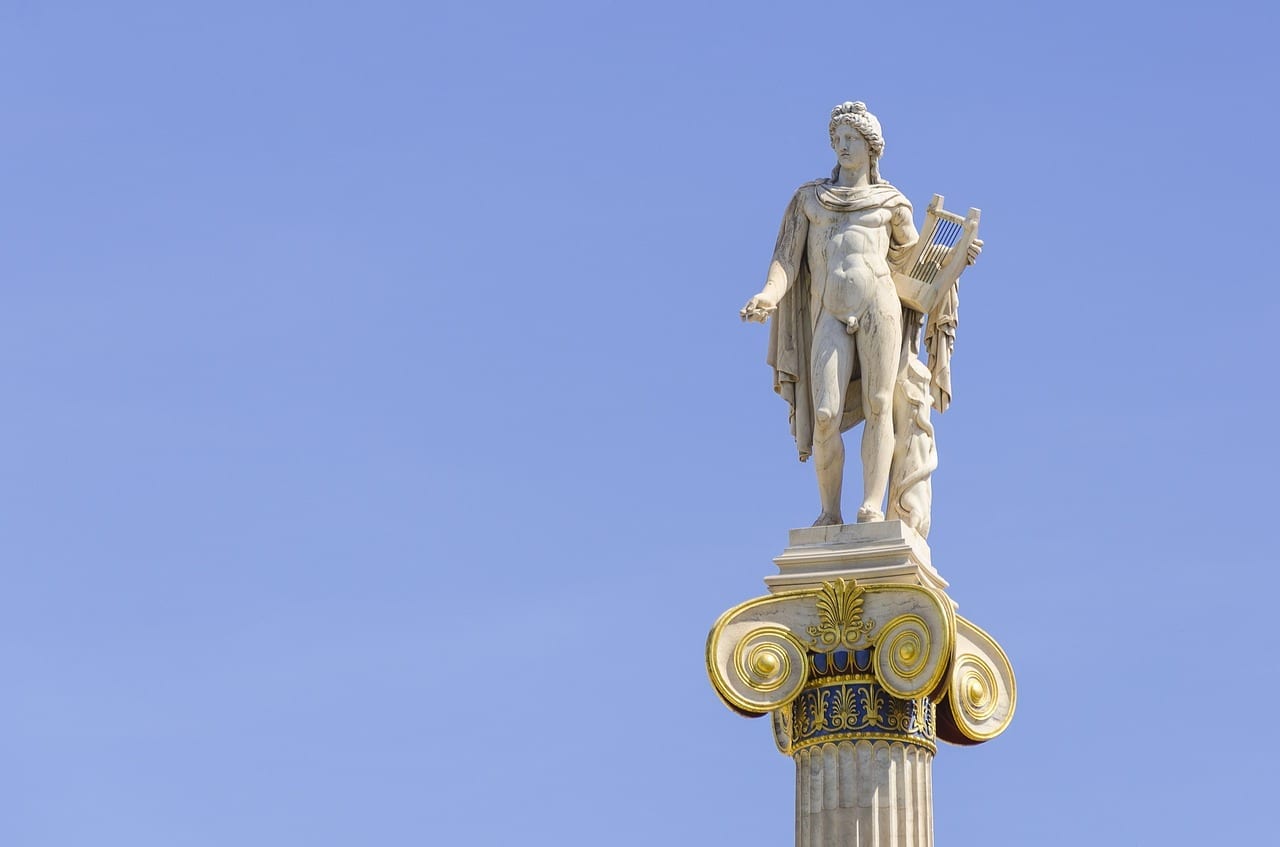
Apollo was the Greek god of music, poetry, prophecy, healing and archery, the twin brother of Artemis and the voice behind the most famous oracle of the ancient world. He was also proud, jealous and dangerous to cross. Here are 15 facts about Apollo, one of the most important gods in Greek mythology.
Apollo at a glance
God of: music, poetry, prophecy, healing, archery and light
Parents: Zeus and Leto
Twin sister: Artemis, goddess of the hunt
Symbols: the lyre, the bow, the laurel wreath
Sacred animals: the swan, the raven, the wolf and the dolphin
Roman name: Apollo (the Romans kept his Greek name)
1He was born on a floating island.
Zeus’s jealous wife Hera banned every land on Earth from sheltering the pregnant Leto. Only Delos, a small rocky island that was said to drift on the sea, agreed to take her in, and there she gave birth to Artemis and then Apollo. Delos became one of the holiest places in Greece.
2The Romans didn’t rename him.
Most Greek gods were given Roman names: Zeus became Jupiter and Hermes became Mercury. Apollo was so admired that the Romans simply adopted him as he was, and the emperor Augustus claimed him as his personal protector.
3His first act was to kill a monster.
While still a child, Apollo killed the Python, a huge serpent that guarded Delphi, with his arrows. He took over the site, and the Pythian Games, held there every four years, were founded in his honour.
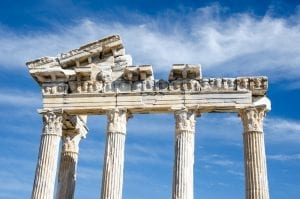
4He spoke through the Oracle of Delphi.
At Delphi, a priestess called the Pythia gave Apollo’s answers to questions from kings, cities and ordinary people. For around a thousand years almost nothing important in the Greek world was decided without consulting her. “Know thyself” was carved at the entrance to his temple.
5He fought Heracles over a tripod.
When the Pythia refused to answer Heracles, the hero tried to carry off her sacred tripod to start his own oracle. Apollo fought him for it, and Zeus had to separate his two sons with a thunderbolt.
6He was the god of healing and of plague.
Apollo was worshipped as a healer, and his son Asclepius became the god of medicine. But his arrows could also bring disease. At the start of Homer’s Iliad, he sends a plague on the Greek army because Agamemnon has captured Chryseis, the daughter of one of Apollo’s priests.
7He was on Troy’s side in the Trojan War.
Apollo protected Hector and the Trojans throughout the war. According to later legend, it was Apollo who guided the arrow of Paris into Achilles’ heel, the only place where the great Greek warrior could be wounded.

8His lyre was a gift from Hermes.
Apollo is the god of music, but he didn’t invent his famous lyre. His baby half-brother Hermes made it from a tortoise shell and gave it to him to make up for stealing his cattle.
9He punished anyone who challenged his music.
When the satyr Marsyas challenged him to a music contest and lost, Apollo had him flayed alive. When King Midas judged the god Pan’s pipes better than Apollo’s lyre, Apollo gave him donkey’s ears.
10The laurel wreath comes from a broken heart.
Apollo fell in love with the nymph Daphne, who ran from him and begged to be saved. As he caught her, she was turned into a laurel tree. Apollo made the laurel his sacred plant, which is why winners at the Pythian Games, and later poets and generals, were crowned with laurel wreaths.
11The hyacinth flower is named after his friend.
Apollo’s beloved companion, the Spartan prince Hyacinthus, was killed by a discus Apollo threw during a game, in some versions blown off course by the jealous west wind. From his blood Apollo made the hyacinth flower grow.
12He cursed Cassandra.
Apollo gave the Trojan princess Cassandra the gift of prophecy in the hope of winning her love. When she turned him down, he couldn’t take the gift back, so he added a curse: her prophecies would always be true, but no one would ever believe them.
13“Phoebus” means bright.
Apollo was often called Phoebus Apollo. The name means “bright” or “shining”, and it links him to his grandmother, the Titan Phoebe. By Roman times he was also linked to the Sun, though the original Greek sun god was Helios.

14The Moon landings were named after him.
NASA’s Apollo programme, which landed twelve astronauts on the Moon between 1969 and 1972, was named by NASA manager Abe Silverstein, who said the image of Apollo riding his chariot across the Sun fitted the scale of the project.
15His temple at Delphi is a World Heritage Site.
The ruins of Apollo’s sanctuary at Delphi, on the slopes of Mount Parnassus, are one of Greece’s most visited ancient sites and were listed by UNESCO in 1987. The Temple of Apollo you can see today dates from the 4th century BC.
FAQs about Apollo
What is Apollo the god of?
Music, poetry, prophecy, healing, archery and light. Later he was also linked with the Sun.
Who were Apollo’s parents?
Zeus, king of the gods, and the Titan Leto. His twin sister is Artemis.
What is Apollo’s weakness?
His pride and jealousy. Many of his myths end badly because someone challenged his skill or rejected his love.
Is Apollo the god of the sun?
Not originally. The Greek sun god was Helios. Apollo was the god of light, and later writers, especially Roman poets, merged the two, so he is often called the sun god today.
Is Apollo the god of truth?
Yes. Because he was the god of prophecy and his oracle at Delphi was believed never to lie, Apollo was seen as a god of truth, and he was said to be unable to tell a lie himself.
What are Apollo’s sacred animals?
The swan, the raven, the wolf and the dolphin. The laurel was his sacred plant.
Did Apollo ever die?
No. In Greek mythology the gods are immortal, so Apollo never dies in any myth.
Is Apollo the same as Helios?
Originally, no. Helios was the Titan who drove the Sun across the sky. Later writers, especially Roman poets, merged the two.
Sources and further reading
Explore more: facts about Hermes and facts about the Greek gods.
Do you know any interesting facts about Apollo? Share them in the comments below!
Spotted something wrong? Suggest a correction
We check every suggestion and update articles when facts change. Thank you for helping keep facts.uk accurate.
One response to “15 Facts About Apollo, the Greek God”
-
Phoebus is Apollo’s forename, which means ‘pure’ or ‘bright’, connecting him to the Titan Phoebe, his grandmother.
Leave a Reply