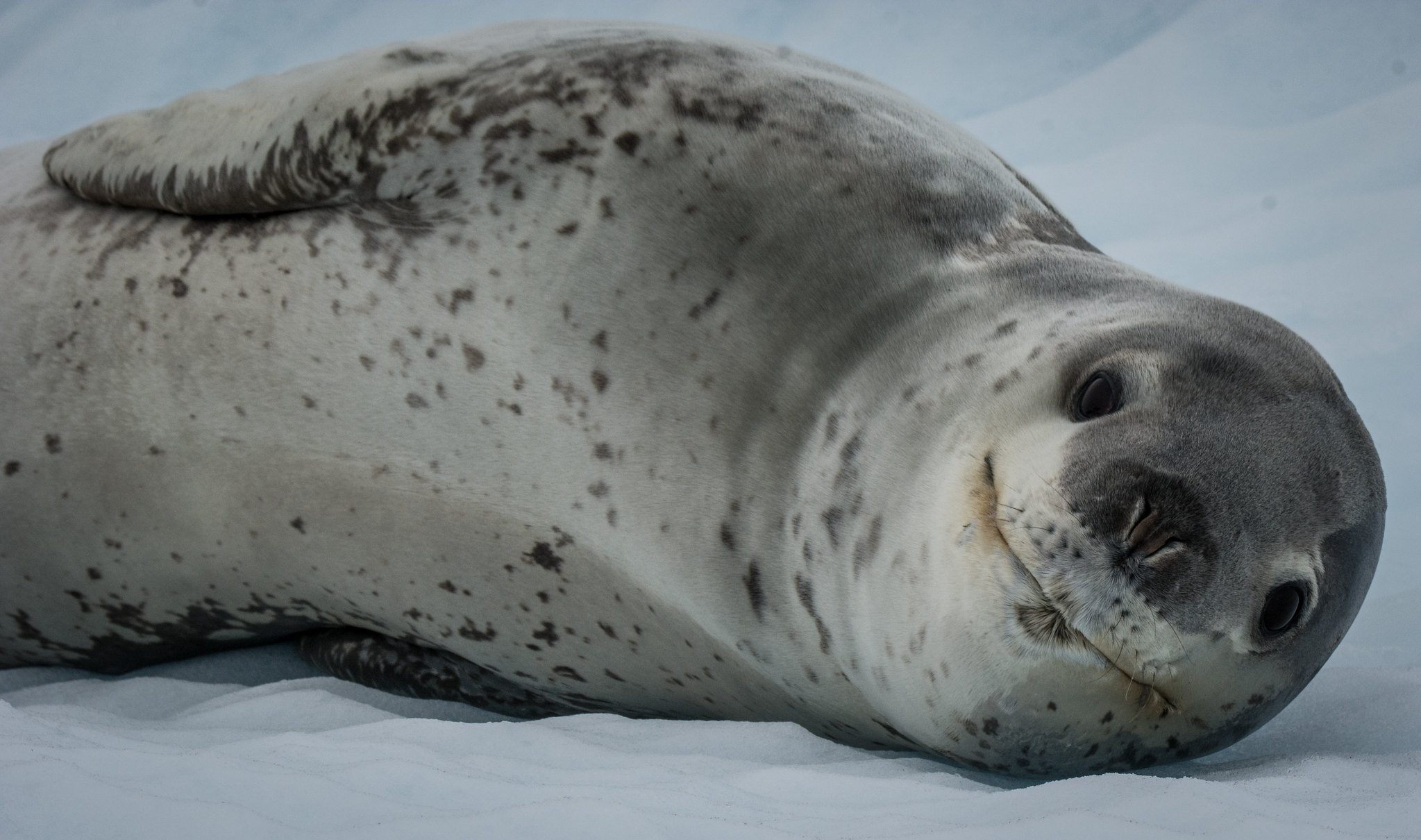
The leopard seal is the Antarctic’s most fearsome seal: a long, spotted, reptile-headed hunter with a huge gape and sharp, inch-long canine teeth. It is the only seal that regularly hunts warm-blooded prey such as penguins and other seals, yet a surprising amount of its diet is tiny krill, which it sieves from the water through specially shaped back teeth.
Here is what makes the “sea leopard” one of the most remarkable animals in the Southern Ocean.
Leopard seal quick facts
Scientific name: Hydrurga leptonyx
Length: females up to about 3.6 m, males up to about 3 m
Weight: females up to about 500 kg, males up to about 300 kg
Teeth: canines around 2.5 cm (1 inch) long, plus three-pointed back teeth for straining krill
Lifespan: over 26 years has been recorded
Where: the pack ice around Antarctica, wandering north to New Zealand, Australia, South America and South Africa
Status: Least Concern (IUCN)
1It is named for its spots, not its speed
The leopard seal gets its name from the dark spots on its silver-grey throat and belly, which look a little like a leopard’s coat. Its scientific name, Hydrurga leptonyx, roughly means “slender-clawed water worker”. Sailors also called it the sea leopard.
2Females are bigger than males
Unusually for seals, female leopard seals are the larger sex. A big female can reach about 3.6 metres long and 500 kg, while males top out at around 3 metres and 300 kg. Only the southern elephant seal is bigger among the true seals of the Antarctic.

3Its teeth do two completely different jobs
At the front, the leopard seal has long, curved canines around 2.5 cm (1 inch) long, used for seizing penguins, fish and other seals. Further back, its cheek teeth have three sharp points each. When the jaws close, these points interlock to form a sieve, so the seal can take in a mouthful of seawater, push the water out and keep the krill behind.
4Its mouth opens remarkably wide
A leopard seal’s jaws are long and loosely hinged, and its gape is enormous compared with other seals, which helps it grab large prey such as penguins whole. Its head looks almost reptilian, broad and flat, more like a giant lizard’s than a typical seal’s.
5Nobody has reliably measured its bite force
You will find bite-force figures quoted online, but there is no well-established scientific measurement of a leopard seal’s bite. What is clear is that its jaws are strong enough to tear apart penguins and young seals, and its bite can cause serious injury to people.
6Krill is a big part of its diet
Despite its fearsome reputation, the leopard seal eats a lot of Antarctic krill, especially in winter when penguins are scarce. It also hunts fish, squid, seabirds and the pups of other seals, particularly crabeater and fur seals. It is an opportunist and takes whatever is easiest to catch.
7It ambushes penguins at the ice edge
Leopard seals often patrol the water close to penguin colonies, waiting near the edge of the ice for birds to dive in. Once it catches a penguin, the seal thrashes it against the water’s surface to strip the skin away from the meat. It can reach speeds of around 40 km/h when it chases prey.
8It is the Antarctic’s top predator after the orca
Apart from killer whales, which sometimes hunt them, adult leopard seals have no natural predators. That puts them near the very top of the Antarctic food chain.
9One killed a scientist in 2003
Attacks on people are very rare, but they do happen. In July 2003 Kirsty Brown, a 28-year-old marine biologist with the British Antarctic Survey, was snorkelling near Rothera Research Station when a leopard seal seized her and held her underwater. She drowned. Divers and kayakers in Antarctica now follow strict rules when a leopard seal is nearby.
10It is not usually dangerous unless you are in its water
Most encounters with leopard seals end without any trouble. They are curious and sometimes approach boats, snapping at inflatable pontoons, but they mostly ignore people on land or ice. The risk comes when people are in the water with them.
11One tried to feed a photographer
National Geographic photographer Paul Nicklen once spent several days in the water with a large female leopard seal. Instead of attacking him, she brought him penguins, first live ones and then dead ones, apparently trying to teach him to hunt or to feed him. His photographs of the encounter became famous around the world.

12Males sing underwater
During the breeding season, male leopard seals make long, eerie underwater calls that can be heard by divers and recorded from far away. Each male repeats his own pattern of sounds, and calls differ from region to region, which suggests there may be separate breeding populations.
13Pups are born on the ice in spring
Pups are born on floating pack ice in November and December, the Antarctic spring. A newborn is over a metre long and weighs close to 30 kg. Mating takes place in the water about a month after the pups are born.
14They sometimes turn up far from Antarctica
In autumn and winter, young leopard seals in particular wander north. They are seen every year on New Zealand’s sub-Antarctic islands and regularly visit mainland New Zealand, where some have stayed for a year or more. They have also turned up in Australia, South America and South Africa.
15They are protected, and not endangered
The IUCN rates the leopard seal as Least Concern. It is protected from commercial hunting under the Antarctic Treaty and the 1972 Convention for the Conservation of Antarctic Seals. Counting them is hard because they live alone on drifting ice, and the population is usually estimated at somewhere between about 220,000 and 440,000.
FAQs about leopard seals
How big are leopard seal teeth?
Their canine teeth are around 2.5 cm (1 inch) long. Their back teeth have three points each and lock together to sieve krill from the water.
How strong is a leopard seal’s bite?
There is no reliable scientific measurement of a leopard seal’s bite force. Its jaws are strong enough to kill and tear apart penguins and young seals, and to badly injure a person.
Has a leopard seal ever killed a human?
Yes, once on record. In 2003 British Antarctic Survey scientist Kirsty Brown was dragged underwater and drowned while snorkelling near Rothera Research Station.
Are leopard seals the most aggressive seals?
They are the most predatory seals, and the only ones that regularly hunt warm-blooded animals. Towards people they are usually curious rather than aggressive, but they can be dangerous in the water.
Where do leopard seals live?
Mainly on the pack ice around Antarctica. In winter some travel north to the sub-Antarctic islands, New Zealand, southern Australia, South America and South Africa.
Do leopard seals eat penguins?
Yes. Penguins are one of their best-known prey, but krill, fish, squid and young seals are just as important to their diet.
Sources and further reading
- New Zealand Department of Conservation: leopard seal
- Pinnipeds.org: leopard seal
- Natural History Museum: are leopard seals dangerous?
Explore more: more sea life facts.
Do you know any fun facts about leopard seals? Share them in the comments below!
Spotted something wrong? Suggest a correction
We check every suggestion and update articles when facts change. Thank you for helping keep facts.uk accurate.

Leave a Reply