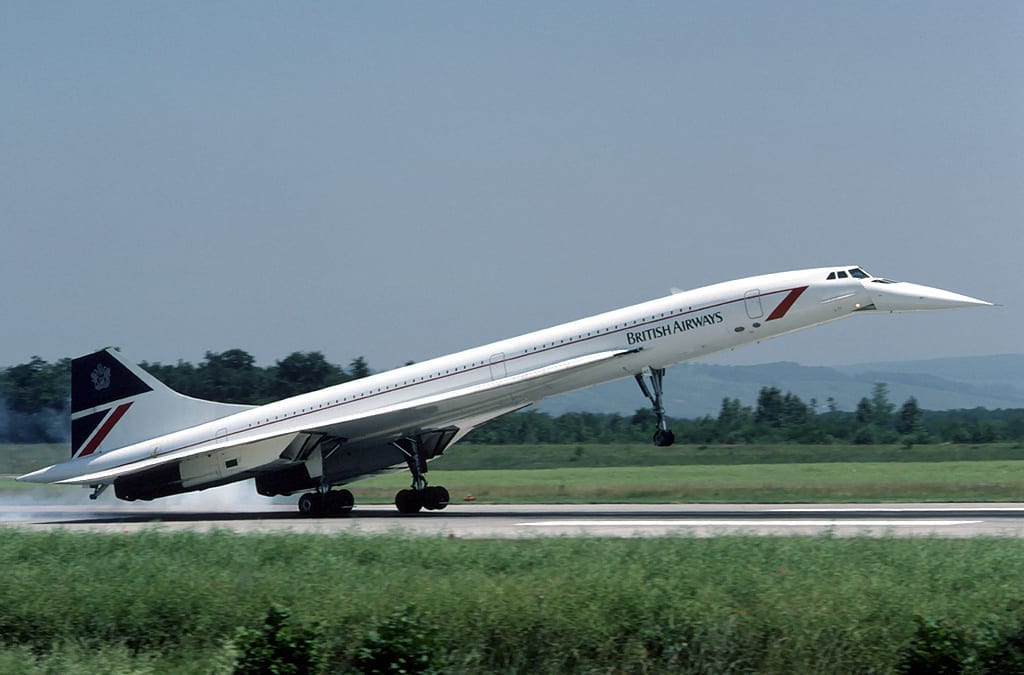
Concorde was the world’s most famous passenger plane. For 27 years it carried passengers across the Atlantic at twice the speed of sound, in less than half the time of an ordinary jet. Its last commercial flight was on 24 October 2003. Here are 15 fun facts about Concorde.
1It was a British and French project.
Concorde was developed jointly by Britain and France under a treaty signed in 1962, with British Aircraft Corporation and France’s Sud Aviation, later Aérospatiale, sharing the work.
2Its name caused an argument.
The British government at first spelled the name “Concord”, without an “e”. In 1967 the minister Tony Benn agreed to the French spelling, joking that the “e” stood for “excellence, England, Europe and entente”.
3It first flew in 1969.
The French prototype took off from Toulouse on 2 March 1969, and the British prototype flew from Filton, near Bristol, on 9 April 1969.
4Passenger flights began in 1976.
On 21 January 1976, British Airways flew from London to Bahrain and Air France from Paris to Rio de Janeiro, both at the same moment. Flights to New York began in 1977.
5A Soviet rival flew first.
The Soviet Tupolev Tu-144, nicknamed “Concordski”, first flew on 31 December 1968, two months before Concorde. It carried passengers for only a few months, so Concorde was the only supersonic airliner to fly regular services for decades.
6It flew at twice the speed of sound.
Concorde cruised at about Mach 2, around 1,350 mph (2,170 km/h), faster than a rifle bullet.
7Passengers could see the curve of the Earth.
Concorde cruised at up to 60,000 feet, almost twice as high as ordinary airliners, where the sky looks dark blue and passengers could see the curvature of the Earth.
8It grew longer in flight.
Friction with the air heated Concorde’s skin to more than 100°C, making the aircraft stretch by around 15 to 25 cm during supersonic flight.
9Its nose drooped.
Concorde’s long, pointed nose could be lowered during take-off and landing so the pilots could see the runway, and raised again for flight.
10Only 20 were ever built.
Of the 20 Concordes built, 14 carried passengers: seven with British Airways and seven with Air France.
11It set a record that still stands.
On 7 February 1996, a British Airways Concorde flew from New York to London in 2 hours, 52 minutes and 59 seconds, the fastest transatlantic crossing by a passenger airliner.
12Phil Collins played Live Aid on both sides of the Atlantic.
On 13 July 1985, Phil Collins performed at Wembley Stadium in London, then flew on Concorde to play at the Live Aid concert in Philadelphia the same day.

13One was painted blue for Pepsi.
In 1996, Air France painted a Concorde blue for a Pepsi advertising campaign. It could only fly at full speed for short periods, because the dark paint absorbed more heat.
14A crash in 2000 began its decline.
On 25 July 2000, an Air France Concorde crashed shortly after take-off from Paris, killing all 109 people on board and four people on the ground. Concorde returned to service in 2001, but falling passenger numbers and rising costs led both airlines to retire it.
15You can still go inside one.
The last Concorde ever to fly, Alpha Foxtrot, landed at Filton on 26 November 2003 and is now on display at Aerospace Bristol. Others can be seen at Brooklands Museum in Surrey, Manchester Airport and the National Museum of Flight at East Fortune in Scotland.
FAQs about Concorde
How fast was Concorde?
Concorde cruised at about Mach 2, or 1,350 mph, twice the speed of sound.
When was Concorde’s last flight?
The last commercial flight was on 24 October 2003, from New York to London Heathrow. The final flight of all was on 26 November 2003, when Alpha Foxtrot flew to Filton.
How long did Concorde take to fly to New York?
Usually about three and a half hours from London, compared with seven to eight hours on a normal airliner.
Sources and further reading
Explore more: facts about the Jumbo Jet and facts about Barbados.
Do you know any fun facts about Concorde? Share them in the comments below!
Spotted something wrong? Suggest a correction
We check every suggestion and update articles when facts change. Thank you for helping keep facts.uk accurate.
2 responses to “15 Fun Facts About Concorde”
-
Concordes wing created so much lift at full speed that it needed to point its nose down 1.5 degrees to maintain a steady altitude.
-
What about the bump on the wing, seen from 3/4 back? Only seen at a certain angle…

Leave a Reply