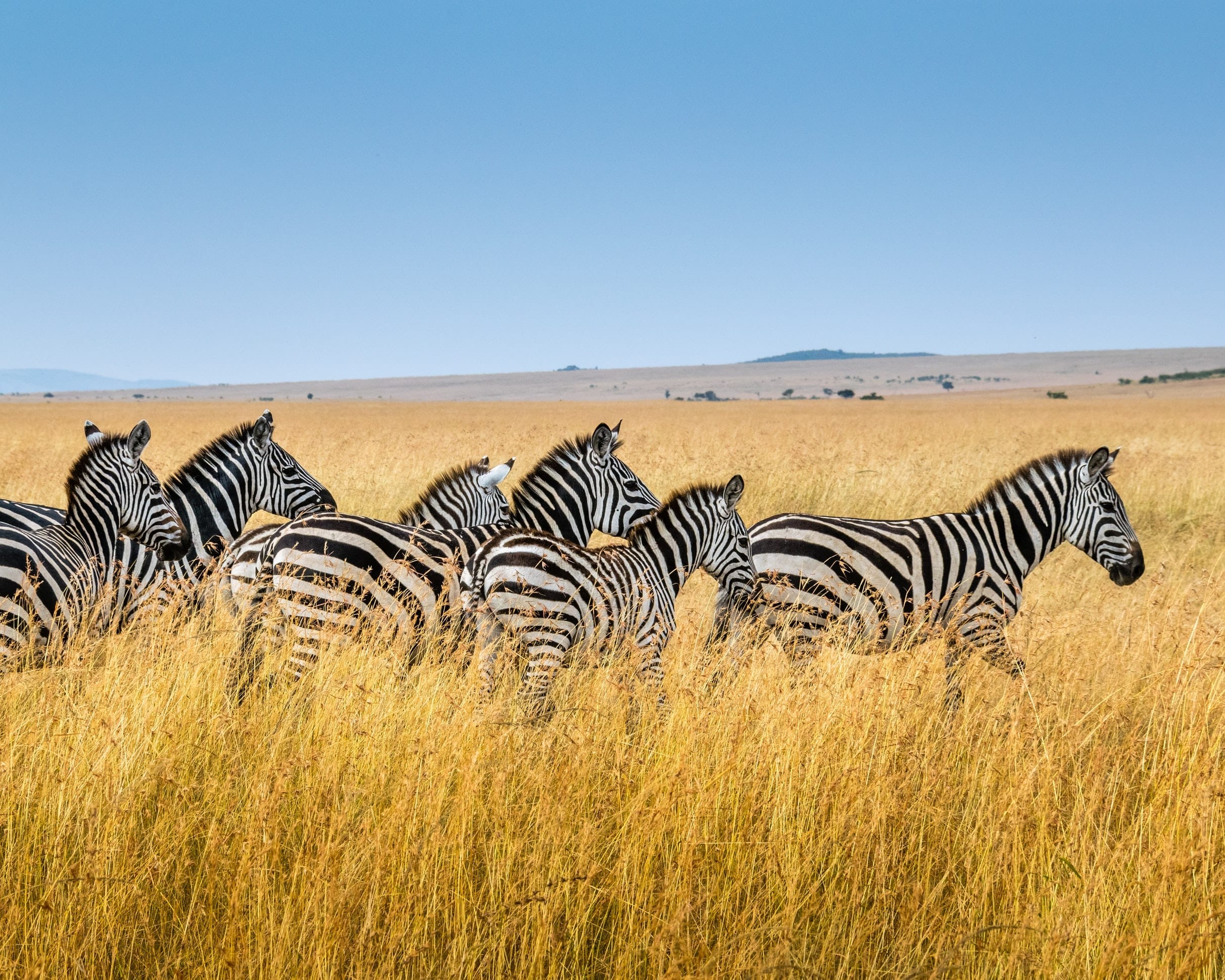
No two zebras have the same stripes, and scientists now think those stripes are mainly there to confuse biting flies. Here are 15 facts about zebras, including whether they’re black with white stripes or white with black stripes.
Zebras at a glance
Species: three: the plains zebra, Grévy’s zebra and the mountain zebra
Where: eastern and southern Africa
Height: about 1.1 to 1.5 m at the shoulder
Top speed: about 65 km/h (40 mph)
Lifespan: about 20 to 25 years in the wild, and up to 40 in zoos
1There are three species of zebra.
The plains zebra is the most common and the one most people picture. Grévy’s zebra, the largest, has narrow stripes and big rounded ears, and the mountain zebra lives on the rocky slopes of South Africa, Namibia and Angola.
2They are black with white stripes.
Under the fur, a zebra’s skin is dark all over. Its coat is made of black hair and white hair, so most scientists describe zebras as black animals with white stripes.
3Every zebra’s stripes are unique.
Like human fingerprints, no two zebras have the same pattern. Researchers use photographs of stripes to identify individual animals in the wild.
4The stripes probably keep flies away.
Scientists have argued for over a century about why zebras have stripes. Experiments in the last few years have found that horseflies struggle to land on striped surfaces, so the leading theory today is that stripes protect zebras from biting insects and the diseases they carry.
5A group of zebras is a “dazzle”.
A group of zebras is called a dazzle or a zeal. Plains zebras live in family groups of a stallion with several mares and their young, and these groups can join together into herds of thousands.
6They take part in a huge migration.
Every year, hundreds of thousands of plains zebras travel with wildebeest in the Great Migration across Tanzania’s Serengeti and Kenya’s Maasai Mara, following the rains and fresh grass.
7They can reach 40 mph.
Zebras can gallop at about 65 km/h (40 mph) and run in zigzags to shake off lions and hyenas. A cornered zebra can also deliver a kick powerful enough to badly injure a predator.

8They can sleep standing up.
Like horses, zebras can doze on their feet, locking their legs so they don’t fall over. For deep sleep they lie down, usually while others in the group keep watch.
9Their ears show their mood.
A zebra’s ears can swivel in almost any direction. Ears pointing forward show it is alert or calm, while ears pinned flat back are a warning sign of anger.
10They walk on a single toe.
Like horses and donkeys, zebras stand on a single hoof at the end of each leg, which is really one enlarged toe.

11They eat mostly grass.
Zebras are grazers and spend much of the day eating tough grasses that other animals avoid. When grass runs short, they also eat leaves, bark, roots and shrubs, and they will dig in dry riverbeds to reach water.

12Zebras and horses can have babies together.
Zebras can breed with horses and donkeys to produce hybrids known as zebroids. A zebra and a horse produce a “zorse”, and a zebra and a donkey a “zonkey”. Zebroids are usually unable to have young of their own.

13Nobody has ever really tamed them.
Zebras are too nervous and aggressive to domesticate like horses. The banker Walter Rothschild famously drove a carriage pulled by zebras through London in the 1890s, but they never caught on.
14One type of zebra became extinct.
The quagga, a South African zebra with stripes only on the front half of its body, was hunted to extinction. The last one died at Amsterdam Zoo in 1883. Genetic studies show it was a form of plains zebra.
15Grévy’s zebra is endangered.
Grévy’s zebra numbers fell from around 15,000 in the 1970s to fewer than 3,000 today, and it survives only in parts of Kenya and Ethiopia. Habitat loss, drought and competition with livestock are the biggest threats.
FAQs about zebras
Are zebras black with white stripes or white with black stripes?
Black with white stripes. Zebra skin is dark underneath, and the white stripes are areas where the hair has no colour.
What eats zebras?
Lions are their main predator, but hyenas, leopards, wild dogs and Nile crocodiles also hunt them.
Why do zebras have stripes?
The best-supported explanation is that stripes put off biting flies such as horseflies. Other ideas, such as confusing predators or keeping cool, have less evidence.
Can you ride a zebra?
Rarely. Zebras are much harder to train than horses, they are not built to carry riders, and they can bite and kick.
Sources and further reading
Do you know any fun facts about zebras? Share them in the comments below!
Spotted something wrong? Suggest a correction
We check every suggestion and update articles when facts change. Thank you for helping keep facts.uk accurate.

Leave a Reply