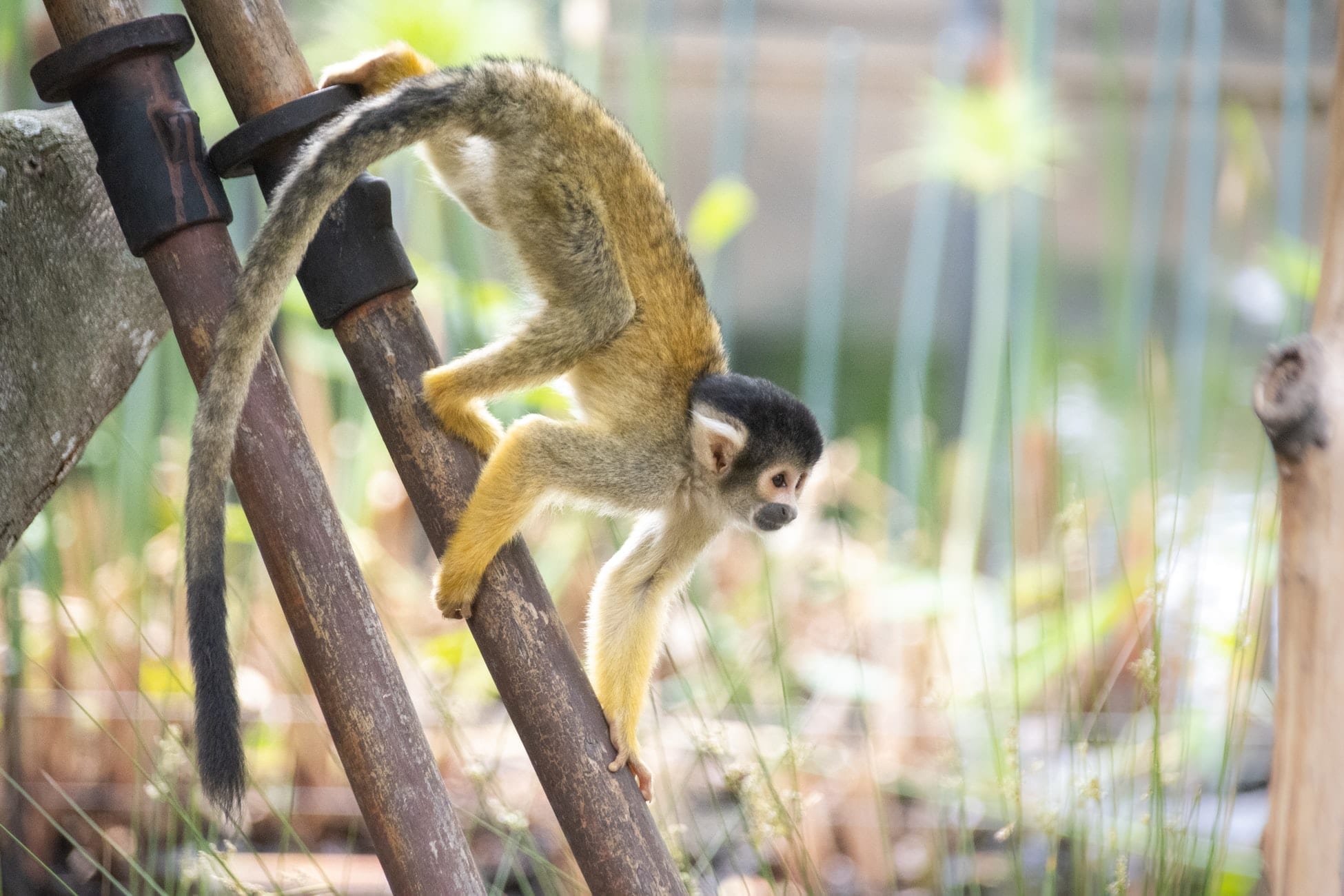
Spider monkeys are long-limbed monkeys that live high in the rainforests of Central and South America. They have almost no thumbs, can hang by their tails and swing through the treetops using their hands as hooks. Here are 17 facts about the spider monkey.
1Spider monkeys live in the rainforests of Central and South America.
Their range stretches from Mexico in the north to Bolivia in the south. Most live in tall tropical rainforest, but some are found in semi-deciduous forest and mangroves.
2There are seven species of spider monkey.
All seven belong to the genus Ateles. They include the Geoffroy’s, brown-headed, brown, white-bellied, white-cheeked, Peruvian and red-faced spider monkeys. Some scientists group them into just four species.
3They get their name from their long, spidery limbs.
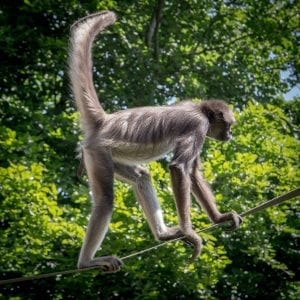
When a spider monkey hangs from a branch by its arms, legs and tail, it looks a bit like a giant spider. In the Central American species the body is 30 to 63 cm long, but the tail can reach 84 cm, so the tail is longer than the rest of the animal.
4Their tail works like a fifth limb.
The tail is prehensile, which means it can grip. It is strong enough to hold the monkey’s whole body weight, leaving both hands free to pick fruit. Spider monkeys can even pick things up with their tails.
5The tip of the tail has its own “fingerprint”.
The underside of the tail tip is a bare patch of skin covered in fine lines, a bit like the ridges on a human fingertip. This pad helps the tail grip branches without slipping.
6Spider monkeys have hardly any thumb.
Their thumb is so small that it does not show on the outside of the hand. Their ancestors had a proper thumb, but it shrank over time. The genus name Ateles comes from a Greek word meaning “imperfect” or “incomplete”, a nod to the missing thumb.
7Their hands work like hooks.
Without a thumb in the way, spider monkeys use their long fingers as hooks to swing from branch to branch, a way of moving called brachiation. Black spider monkeys spend about 90% of their time in the upper canopy, often more than 25 metres above the ground.
8Most of their food is ripe fruit.
For much of the year more than 85% of a spider monkey’s diet is ripe fruit. They also eat leaves, flowers, seeds and the odd insect, and turn to honey, bark and decaying wood when fruit is scarce.
9They often swallow fruit whole.
One study of black spider monkeys found they swallowed fruit whole about 40% of the time.
10Spider monkeys plant the rainforest.
Because they eat so much fruit, spider monkeys drop seeds all over the forest in their droppings. This makes them important seed dispersers for many rainforest trees.
11Their groups split up and come back together.
A spider monkey community usually has 15 to 30 members, but they rarely all travel together. They split into small foraging parties of about three animals, then regroup. Scientists call this a fission-fusion society, and chimpanzees live the same way.
12Adult females often lead the foraging parties.
The small subgroups are often led by dominant adult females. The size of these parties changes with the food supply: they are biggest when fruit is plentiful and smallest when it is scarce.
13Females leave home, but males stay.
Young female spider monkeys leave the group they were born into to find mates, while males usually stay in their home group. Black spider monkey females often return to their birth group to have their babies.
14They bark at danger and whinny to find each other.
Spider monkeys scream, grunt, whistle and bark. They bark when threatened, and may shake branches or throw them at intruders. When they are separated, they use a call that sounds like a horse’s whinny to keep in touch.
15Jaguars, big birds of prey and humans hunt them.
Their natural predators include jaguars, pumas, eagles and large snakes. Humans are the biggest threat, as spider monkeys are hunted for food in many areas.
16Spider monkeys breed very slowly.
A female gives birth to a single baby after a pregnancy of about seven and a half months (226 to 232 days). She usually has a baby only every two to four years, so populations take a long time to recover.
17Every species is under threat.
All seven species are on the IUCN Red List as threatened, from Vulnerable (the red-faced spider monkey) to Critically Endangered (the brown spider monkey). The main dangers are forest loss, hunting and the pet trade.
FAQs about spider monkeys
Do spider monkeys have thumbs?
Not on the outside. Spider monkeys have only a tiny, reduced thumb bone hidden in the hand, so their hands look thumbless and work like hooks.
Are spider monkeys dangerous?
Spider monkeys are wild animals, and adults, especially males, are strong and may bite if they are stressed or upset. They bark, shake branches and throw sticks to warn off intruders.
How long do spider monkeys live?
In the wild they usually live for about 20 years. In zoos they can live much longer, with some reaching their 40s.
Sources and further reading
- Wisconsin National Primate Research Center: Black spider monkey
- Animal Diversity Web (University of Michigan): Ateles geoffroyi
- Animal Diversity Web (University of Michigan): Ateles paniscus
- New England Primate Conservancy: Spider monkeys
Explore more: facts about monkeys, facts about the Amazon rainforest and facts about jaguars.
Do you know any fun facts about the spider monkey? Share them in the comments below!
Spotted something wrong? Suggest a correction
We check every suggestion and update articles when facts change. Thank you for helping keep facts.uk accurate.

Leave a Reply