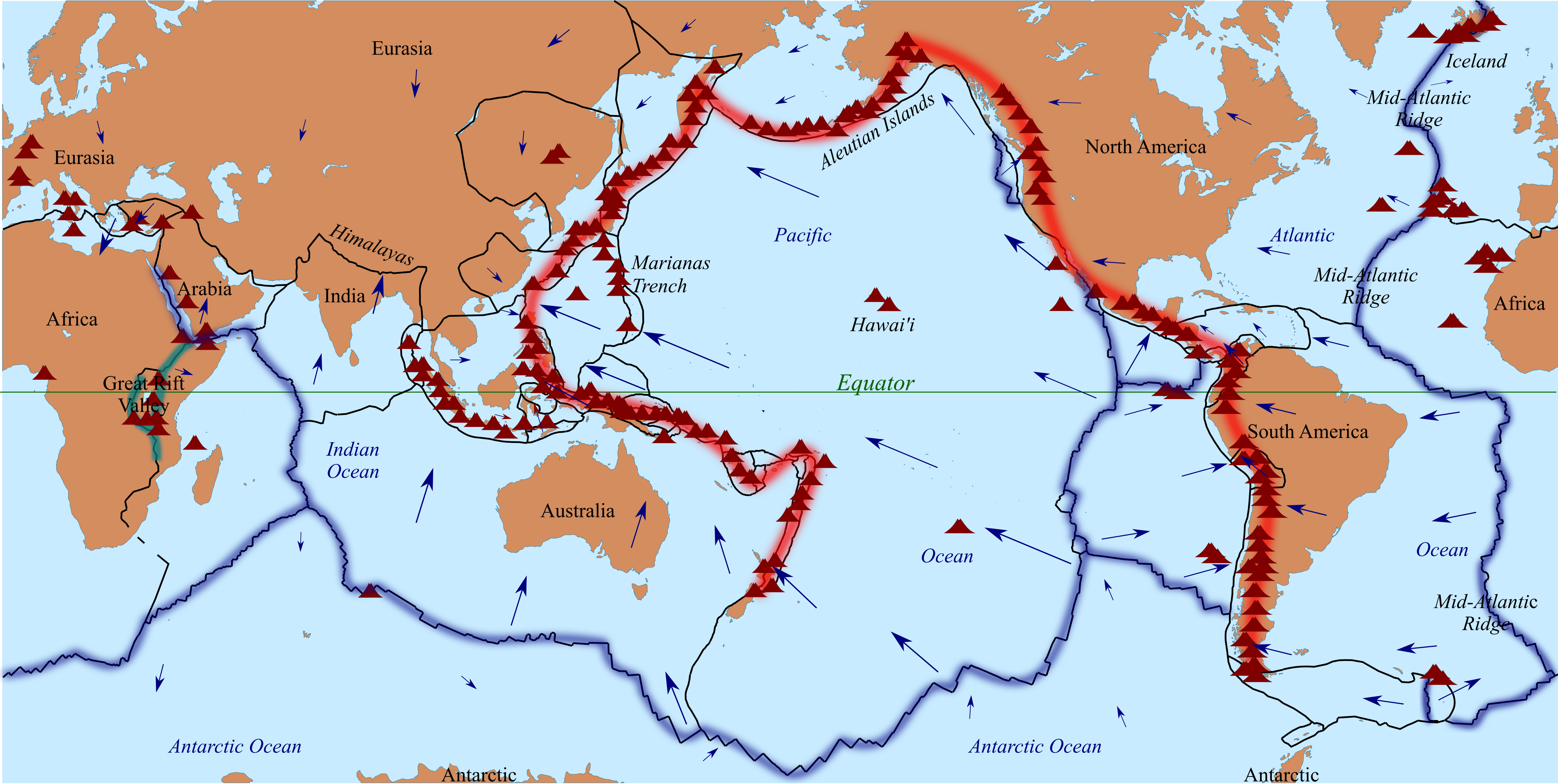
The Ring of Fire is a 40,000 km horseshoe of volcanoes and earthquake zones around the edge of the Pacific Ocean. It is home to about three-quarters of the world’s volcanoes and is where around 90% of all earthquakes happen, including the biggest ever recorded. Here are 15 fun facts about the Ring of Fire.
The Ring of Fire at a glance
What: a belt of volcanoes and earthquake zones around the Pacific Ocean
Length: about 40,000 km (25,000 miles)
Volcanoes: around 450, about 75% of the world’s active and dormant volcanoes
Earthquakes: about 90% of the world’s total
Deepest point: the Mariana Trench
1It isn’t really a ring.
Despite the name, the Ring of Fire is shaped like a horseshoe. It runs down the west coast of the Americas, across the Aleutian Islands of Alaska, down through Russia, Japan, the Philippines and Indonesia, and on to New Zealand, with a gap in the south where there are few volcanoes.
2It is about 40,000 km long.
That is roughly the distance around the Earth at the equator, and it touches the coasts of more than 15 countries.

3It has around 450 volcanoes.
About three-quarters of the world’s active and dormant volcanoes lie along the Ring of Fire, including Mount Fuji, Mount St. Helens, Krakatoa and Mount Pinatubo.
4About 90% of earthquakes happen there.
According to the US Geological Survey, around 90% of all earthquakes, and about 80% of the largest ones, occur along the Ring of Fire.
5It is caused by moving plates.
The Ring of Fire follows the edges of the Pacific Plate and several smaller plates. In most places one plate is sinking beneath another, a process called subduction, which melts rock to feed volcanoes and builds up stress that is released as earthquakes.
6The biggest earthquake ever recorded happened there.
On 22 May 1960, a magnitude 9.5 earthquake struck near Valdivia in Chile. It is the most powerful earthquake ever measured, and its tsunami crossed the Pacific to cause deaths in Hawaii, Japan and the Philippines.
7Japan sits on four plates.
Japan lies where four tectonic plates meet, and it has more than 100 active volcanoes. In 2011, the magnitude 9.0 Tōhoku earthquake and tsunami killed more than 18,000 people and caused the Fukushima nuclear disaster.
8Mount Fuji is part of it.
Japan’s highest and most famous mountain is an active volcano on the Ring of Fire. It last erupted in 1707, covering the city of Edo, now Tokyo, in ash.

9Krakatoa was heard thousands of kilometres away.
When Krakatoa in Indonesia erupted in 1883, the explosion was heard nearly 5,000 km away and its tsunamis killed more than 36,000 people. Ash in the sky turned sunsets red around the world for months.
10One eruption cooled the whole planet.
The 1991 eruption of Mount Pinatubo in the Philippines threw so much gas and ash into the atmosphere that average global temperatures dropped by about 0.5°C for the following year. It was the second-largest eruption of the 20th century.
11An undersea volcano made the biggest explosion in modern times.
In January 2022, the Hunga Tonga-Hunga Ha’apai volcano in Tonga erupted beneath the sea. Its blast was heard in Alaska, its pressure wave circled the globe several times, and its plume reached higher into the atmosphere than any eruption on record.
12Most of its volcanoes are underwater.
Many of the Ring of Fire’s volcanoes lie hidden beneath the Pacific, and new undersea volcanoes are still being found.
13It contains the deepest place on Earth.
The Mariana Trench, where the Pacific Plate dives beneath the Mariana Plate, is part of the Ring of Fire. Its deepest point is nearly 11 km below sea level.
14It sits around a “peaceful” ocean.
The Portuguese explorer Ferdinand Magellan named the Pacific Ocean Mar Pacífico, the “peaceful sea”, in 1520 because its waters seemed so calm after a stormy voyage. The name is rather ironic given the violent ring around its edge.

15Its heat powers homes.
Countries on the Ring of Fire, including New Zealand, Indonesia, the Philippines and the western United States, use the heat from underground to produce geothermal electricity. The Philippines and Indonesia are among the world’s biggest producers.
FAQs about the Ring of Fire
What is the Ring of Fire?
A horseshoe-shaped zone around the Pacific Ocean where tectonic plates meet, causing frequent earthquakes and volcanic eruptions.
How many volcanoes are in the Ring of Fire?
Around 450, which is about 75% of the world’s active and dormant volcanoes.
Which countries are in the Ring of Fire?
They include Chile, Peru, Mexico, the United States, Canada, Russia, Japan, the Philippines, Indonesia, Papua New Guinea, Tonga and New Zealand, among others.
Is the UK in the Ring of Fire?
No. The UK is far from any plate boundary, which is why it has small earthquakes and no active volcanoes.
Sources and further reading
Explore more: facts about the Mariana Trench.
Do you know any fun facts about the Ring of Fire? Share them in the comments below!
Spotted something wrong? Suggest a correction
We check every suggestion and update articles when facts change. Thank you for helping keep facts.uk accurate.
Leave a Reply