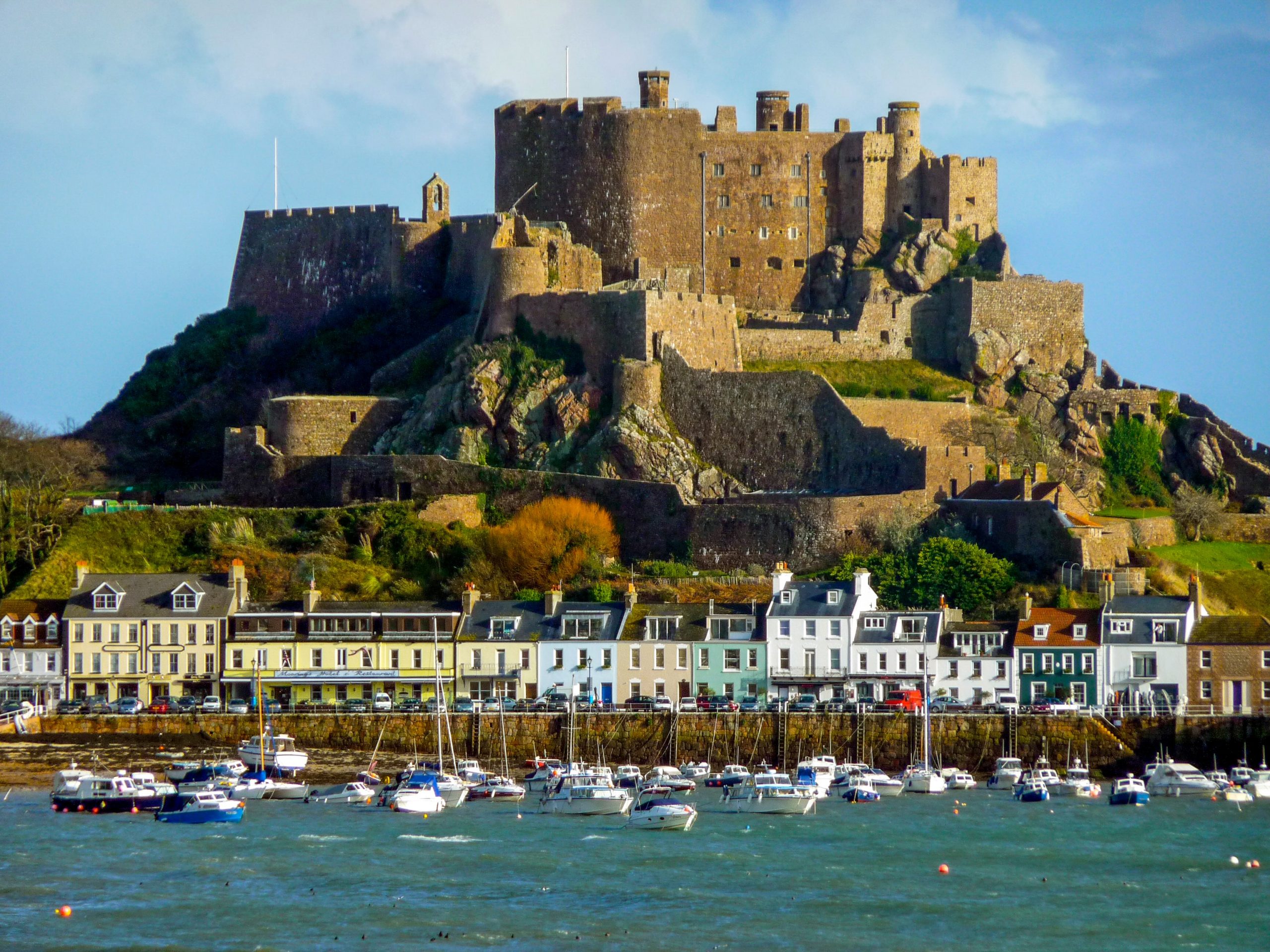
Jersey is only nine miles by five, yet it has its own parliament, its own banknotes, one of the biggest tides on Earth and a breed of cow known all over the world. Here are 12 facts about Jersey, the largest of the Channel Islands.
Jersey at a glance
Where: about 14 miles off the coast of Normandy, France
Area: about 46 square miles (119 km²)
Population: about 103,000 (2021 census)
Capital: St Helier
Status: a self-governing British Crown Dependency
1Jersey isn’t part of the UK.
Jersey is a Crown Dependency: the King is head of state, and the UK handles its defence and foreign affairs, but the island makes its own laws and sets its own taxes through its parliament, the States Assembly. It isn’t part of the United Kingdom, and it was never part of the European Union.
2It has its own money.
Jersey issues its own pound notes and coins, worth exactly the same as sterling. UK money is accepted everywhere on the island, but Jersey notes aren’t legal tender in the UK, so most visitors swap them back before they leave. Jersey still prints a £1 note, which the Bank of England withdrew in 1988.
3The island almost doubles in size at low tide.
Jersey has one of the largest tidal ranges in the world, up to about 12 metres on the biggest spring tides. At low tide, so much rock and sand is uncovered that the island nearly doubles in size, and you can walk out to places such as Seymour Tower, more than a mile offshore, with a guide.

4The Germans occupied it for five years.
Jersey was the only part of the British Isles, along with the other Channel Islands, to be occupied by Germany in the Second World War, from 1 July 1940 until 9 May 1945. Islanders still celebrate 9 May as Liberation Day, and the tunnels dug by forced labourers are now the Jersey War Tunnels museum.
5Jersey cows have been kept pure since 1789.
To protect its famous dairy breed, Jersey banned the import of cattle from France in 1789, and the island’s herd has been kept separate ever since. Jersey cows, known for their rich, creamy milk, are now farmed all over the world, from the USA to New Zealand.
6Jersey Royals are the island’s famous potatoes.
The small, waxy Jersey Royal new potato has protected status, like Champagne, so only potatoes grown on the island can use the name. The island is also known for its oysters, lobsters and crab, and for Jersey Black Butter, a spiced apple preserve.
7It was the first place to proclaim Charles II king.
After Charles I was executed in 1649, Jersey’s bailiff, Sir George Carteret, proclaimed his son King Charles II in St Helier’s Royal Square, before England had a king again. The young Charles had sheltered on the island during the Civil War, and he later rewarded Carteret with land in America, which Carteret named New Jersey.

8Victor Hugo lived here in exile.
The author of Les Misérables fled France after Napoleon III seized power and lived in Jersey from 1852 to 1855. He was expelled after a newspaper he supported criticised Queen Victoria, so he moved to neighbouring Guernsey, where he finished his most famous novel.
9Islanders speak their own language.
English is the main language, but the island has its own Norman language, Jèrriais, which is still taught in schools and appears on road signs. French is used in some legal ceremonies, and Portuguese is widely spoken because of a large community from Madeira.
10It was home to golf’s most successful Open champion.
Harry Vardon was born in Grouville in 1870 and learned to play on the links there. He won the Open Championship six times, still a record, and the “Vardon grip” he popularised is the way most golfers hold a club today.
11Superman is from Jersey.
Actor Henry Cavill, who played Superman in Man of Steel and The Witcher’s Geralt of Rivia, was born and grew up on the island.
12It has been loyal to the English Crown since 1204.
Jersey was once part of the Duchy of Normandy. When King John lost mainland Normandy to France in 1204, the Channel Islands stayed loyal to the English Crown, which is why they are British today despite lying so close to France. Mont Orgueil Castle at Gorey was built soon afterwards to defend the island.

FAQs about Jersey
Is Jersey part of the UK?
No. It is a self-governing Crown Dependency. The King is head of state, but Jersey makes its own laws and is not represented in the UK Parliament.
Do you need a passport to go to Jersey?
Not if you’re travelling from the UK, as Jersey is part of the Common Travel Area, but carriers usually ask for photo ID.
Can you use English money in Jersey?
Yes. UK notes and coins are accepted everywhere on the island.
Can UK citizens live and work in Jersey?
Yes, but Jersey controls housing and work through its own residential status rules, so newcomers can’t live in all types of housing or take all jobs straight away.
Sources and further reading
Explore more: more facts about the Channel Islands.
Do you know any fun facts about Jersey? Share them in the comments below!
Spotted something wrong? Suggest a correction
We check every suggestion and update articles when facts change. Thank you for helping keep facts.uk accurate.
Leave a Reply