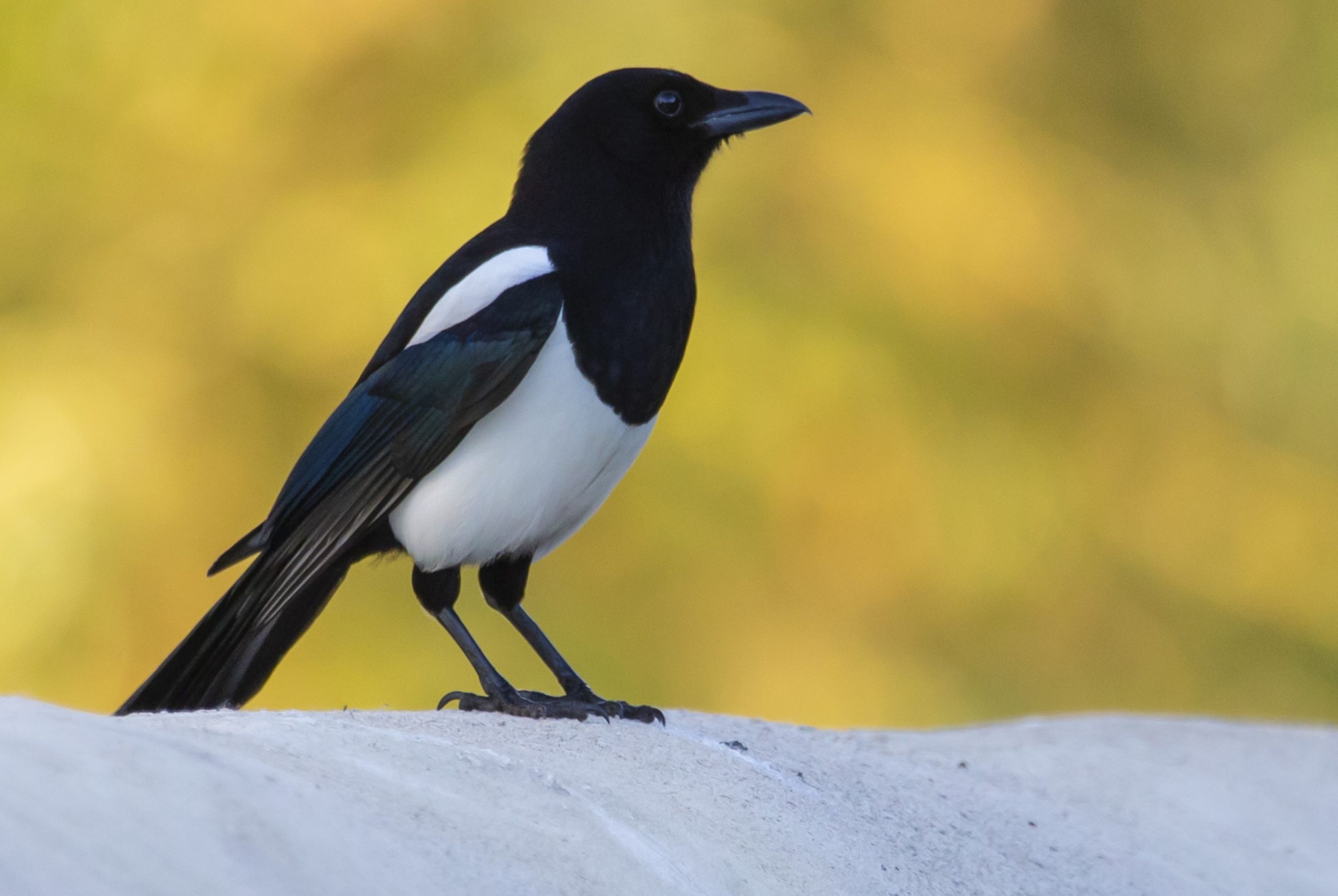
Magpies can recognise themselves in a mirror, usually stay with one partner for life, and have been blamed for bad luck for centuries. But they don’t really steal shiny things. Here are 16 facts about magpies, from the “one for sorrow” rhyme to why Australia’s magpie isn’t a magpie at all.
The magpie at a glance
Species in Britain: the Eurasian magpie (Pica pica)
Family: crows (corvids)
Length: about 45 cm, over half of it tail
Typical lifespan: 3 to 5 years in the wild, though some live far longer
UK population: around 600,000 breeding territories
1Magpies are members of the crow family.
Magpies belong to the corvids, along with crows, rooks, ravens, jackdaws and jays, a family famous for its intelligence. The black-and-white Eurasian magpie is the one found across Britain, Europe and much of Asia.
2They can recognise themselves in a mirror.
In a 2008 experiment, magpies with a coloured mark on their throat feathers looked in a mirror and tried to remove it. They were the first non-mammals shown to pass this “mirror test”, which only a few species, including great apes, dolphins and elephants, are known to pass.
3Their black feathers aren’t really black.
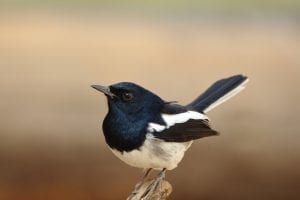
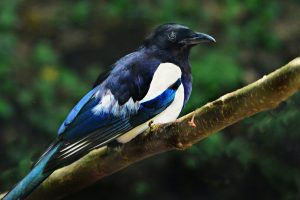
Seen up close in sunlight, the magpie’s “black” wings and tail shimmer with blue, purple and green. The colours come from the microscopic structure of the feathers, not from pigment.
4Over half their length is tail.
A magpie is around 45 cm long, and its tail makes up more than half of that. The long tail helps it twist and turn quickly in flight and plays a part in courtship displays.
5They don’t actually steal shiny things.
The idea of the “thieving magpie” goes back at least to a French play of 1815 and Rossini’s opera La gazza ladra of 1817, in which a servant girl is nearly executed for thefts carried out by a magpie. When researchers at the University of Exeter tested the myth in 2014, the birds were wary of shiny objects rather than attracted to them.
6“One for sorrow, two for joy”.
Seeing a single magpie has been considered unlucky in Britain for centuries, which is where the counting rhyme “One for sorrow, two for joy, three for a girl, four for a boy” comes from. Many people still salute a lone magpie or say “Good morning, Mr Magpie” to ward off the bad luck.
7In East Asia they are lucky birds.
In China, a magpie’s call is said to bring good news, and in Korea the magpie is often called the country’s unofficial national bird. In a Chinese legend, magpies form a bridge across the Milky Way once a year so two separated lovers can meet.
8They usually pair for life.
Magpies are mostly monogamous, and a pair often stays together year after year, defending the same territory. Pairs build a large, domed nest of sticks with a roof, which can take weeks to finish.
9A female usually lays five or six eggs.
Eggs are laid in spring and hatch after about 20 days. The young leave the nest at around four weeks old but stay close to their parents for several weeks more while they learn to find food.
10They will eat almost anything.
Magpies eat beetles, worms and other invertebrates for most of the year, plus seeds, berries, scraps and roadkill. In spring they also take eggs and chicks from other birds’ nests, which has given them a bad reputation with gardeners.
11But they haven’t caused songbird declines.
Magpie numbers in Britain grew strongly from the 1970s before levelling off in the 1990s. Several studies, including research by the British Trust for Ornithology, found no evidence that magpies caused the long-term fall in songbird populations, which is mostly due to changes in farming and habitat.
12They hardly ever leave home.
Magpies don’t migrate. Most spend their whole lives within a few kilometres of where they hatched, and in winter they often gather in large communal roosts.
13A group of magpies has several names.
A group of magpies is often called a “mischief”, a “tidings” or a “gulp”. Whatever the name, gatherings of a dozen or more are common in late winter, when young birds are looking for partners and territories.
14Australia’s “magpie” isn’t a magpie.
The black-and-white Australian magpie, famous for swooping on people in nesting season, isn’t related to the Eurasian magpie at all. It is a butcherbird, and early settlers named it after the bird it reminded them of back home.
15They are rarer in Scotland than in England.
Magpies are found across almost all of England, Wales and Northern Ireland, and especially in towns and suburbs, but they are absent from most of the northern half of Scotland and its islands, although they have been spreading north in recent decades.
16Some have lived for over 20 years.
Most wild magpies live only a few years, but ringing records show they can live much longer: the oldest known wild magpie in Britain was more than 21 years old.
FAQs about magpies
Do magpies mate for life?
Usually, yes. Most magpie pairs stay together for life and defend the same territory year after year, though a bird will find a new partner if its mate dies.
Are magpies native to the UK?
Yes. The Eurasian magpie is a native British bird, found throughout England, Wales and Northern Ireland but much rarer in northern Scotland.
Are magpies intelligent?
Very. They can recognise themselves in a mirror, remember human faces, and solve problems, which puts them among the most intelligent birds in the world.
What do magpies eat?
Mainly insects, worms and other invertebrates, plus seeds, berries, scraps and carrion. In spring they also eat eggs and chicks from other nests.
Why do people salute magpies?
It is an old British superstition: greeting a lone magpie is meant to cancel out the bad luck of “one for sorrow”.
Sources and further reading
Do you know any fun facts about magpies? Share them in the comments below!
Spotted something wrong? Suggest a correction
We check every suggestion and update articles when facts change. Thank you for helping keep facts.uk accurate.
One response to “16 Magpie Facts: Do They Mate for Life, and Are They Lucky?”
-
for years in 1970s my dad had one from young and it spoke better than a miner bird

Leave a Reply