Demon Slayer: Kimetsu no Yaiba is a Japanese manga by Koyoharu Gotouge about a boy who becomes a demon hunter to save his sister. It became one of the best-selling manga ever, and its anime films have broken box office records in Japan, the UK and around the world. Here are 19 facts about Demon Slayer.
1Kimetsu no Yaiba means “Blade of Demon Destruction”.
The working title was Kisatsu no Yaiba, using the word for “kill”. Gotouge felt that was too blunt, so swapped in “kimetsu”, a made-up word meaning roughly “demon destruction”. “Yaiba” means blade and suggests a Japanese sword.
2The story is set in Japan’s Taishō era.
The Taishō era ran from 1912 to 1926. Tanjiro Kamado, a young charcoal seller, comes home to find his family killed by a demon and his younger sister Nezuko turned into one. He joins the Demon Slayer Corps, a secret group that has fought demons for centuries, to find a way to turn her back into a human.

3It grew out of Gotouge’s first ever manga.
Gotouge’s debut one-shot, Kagarigari, became the basis for a draft called Kisatsu no Nagare. The editor, Tatsuhiko Katayama, turned it down as too serious and asked for a brighter, more ordinary hero in the same world. That hero became Tanjiro.
4The manga ran in Weekly Shōnen Jump for four years.
Demon Slayer was serialised in Shueisha’s Weekly Shōnen Jump from 15 February 2016 to 18 May 2020. The complete story is collected in 23 volumes, the last of which came out in December 2020.
5Gotouge was named on the TIME100 Next list in 2021.
TIME magazine put Koyoharu Gotouge in the “Phenoms” section of its TIME100 Next list of rising stars in 2021, alongside actors, athletes and activists. It was a rare honour for a manga creator.
6All demons come from one original demon, Muzan Kibutsuji.
Muzan is the first demon and the source of all the others. In the story, demons heal almost instantly, so the only sure ways to kill one are sunlight or cutting off its head with a special Nichirin sword. Wisteria flowers also repel demons, and one character turns wisteria into a poison.

7The manga has more than 220 million copies in circulation.
In July 2025 the publisher Shueisha announced that the series had passed 220 million copies, including digital editions. About 164 million of those were in Japan and about 56 million overseas.
8It was Japan’s best-selling manga in both 2019 and 2020.
Demand peaked at the end of the series. When the final volume, number 23, was released in December 2020, it sold a record 2.855 million copies in its first week.
9The anime made the manga a hit.
Studio Ufotable’s 26-episode first season aired from April to September 2019. The manga had been running for three years, but sales took off once the anime brought the story to a much wider audience.
10The strongest demon slayers are called the Hashira.
Hashira means “pillars”, and they are the elite swordsmen at the top of the Demon Slayer Corps. Each one has their own breathing style, such as Flame, Water or Insect, which lets them fight with superhuman speed and strength.

11There are four TV seasons.
After the first season came an 18-episode second season (October 2021 to February 2022), an 11-episode third season set in the Swordsmith Village (April to June 2023) and an eight-episode fourth season about Hashira Training (May to June 2024).
12Mugen Train is Japan’s highest-grossing film ever.
Demon Slayer: Kimetsu no Yaiba The Movie: Mugen Train opened in October 2020 and took ¥40.8 billion at the Japanese box office. That beat Studio Ghibli’s Spirited Away, which had held the record since 2001.
13Its theme song won Japan’s top music award.
LiSA’s “Homura”, the theme song for Mugen Train, won Song of the Year at the 62nd Japan Record Awards in December 2020. LiSA also sang “Gurenge”, the opening song of the first TV season.
14The most powerful demons are the Twelve Kizuki.
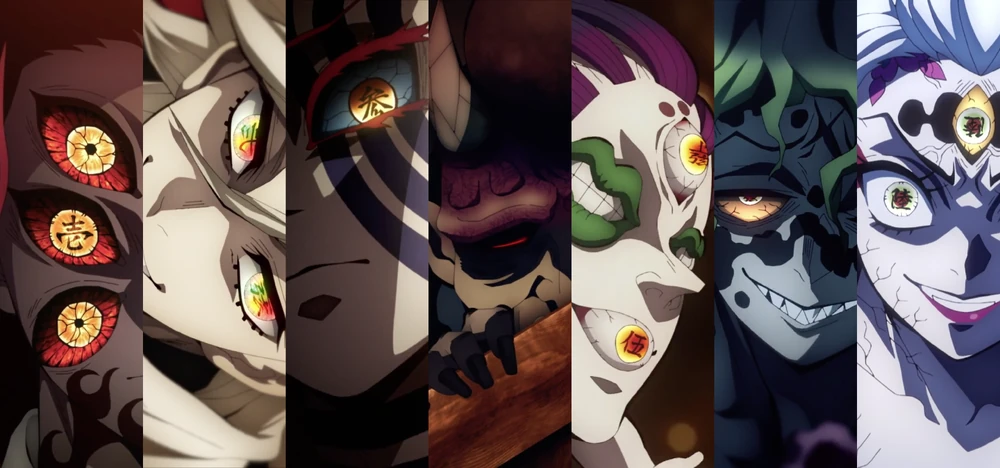
The Twelve Kizuki, or Twelve Moons, are Muzan’s strongest followers. They are split into six Upper Moons and six Lower Moons, and each one has its rank written in its eyes. The Upper Moons are far stronger, and some of them have survived for hundreds of years.
15The story ends with a trilogy of films, not a TV season.
The final arc is being told as three Infinity Castle films. The first opened in Japan on 18 July 2025 and became the first Japanese film to take more than ¥100 billion at the box office worldwide, with 89.2 million tickets sold by mid-November 2025. In Japan it sits just behind Mugen Train.
16Infinity Castle set a UK record for an anime film.
The film opened in the UK on 12 September 2025 and took £3.4 million in its first weekend on nearly 500 screens. That was the biggest opening for an anime film ever in the UK and Ireland.
17Cinemagoers were given a free bonus book.
People who saw Mugen Train in Japan in October 2020 received “Volume 0”, an 84-page booklet about the Flame Hashira, Kyojuro Rengoku. A total of 4.5 million copies were printed.
18Side characters have their own spin-off stories.
A two-chapter side story about the Water Hashira, Giyu Tomioka, appeared in April 2019, followed by one about Kyojuro Rengoku in October 2020. They were published in English as Stories of Water and Flame in 2022. There is also Kimetsu Academy, a comedy that puts the characters in a modern school.
19There are Demon Slayer stage plays too.
The first stage play ran in Tokyo and Kobe in January and February 2020. More followed, and the fifth, based on the Swordsmith Village arc, opened in Tokyo in April 2025.
FAQs about Demon Slayer
Will there be a season 5 of Demon Slayer?
No. The final part of the story is being told as the three Infinity Castle films instead. Part 1 came out in 2025. In November 2026, Part 2 still had no release date.
What order should I watch Demon Slayer in?
Watch season 1, then the Mugen Train film (or the Mugen Train arc at the start of season 2), then the Entertainment District arc, season 3 (Swordsmith Village), season 4 (Hashira Training) and finally the Infinity Castle films.
Is the Demon Slayer manga finished?
Yes. The manga ended in May 2020 and the full story is in 23 volumes. The anime is still catching up with the ending through the Infinity Castle films.
Sources and further reading
- Nippon.com: “Demon Slayer: Infinity Castle” Global Box Office Tops ¥100 Billion
- Anime News Network: Demon Slayer: Infinity Castle Becomes Highest-Earning Anime Film in U.K. and Ireland
- TIME: 2021 TIME100 Next
- Wikipedia: Demon Slayer: Kimetsu no Yaiba
Explore more: facts about anime, facts about One Piece and facts about Japan.
Do you know any fun facts about Demon Slayer? Share them in the comments below!
Spotted something wrong? Suggest a correction
We check every suggestion and update articles when facts change. Thank you for helping keep facts.uk accurate.