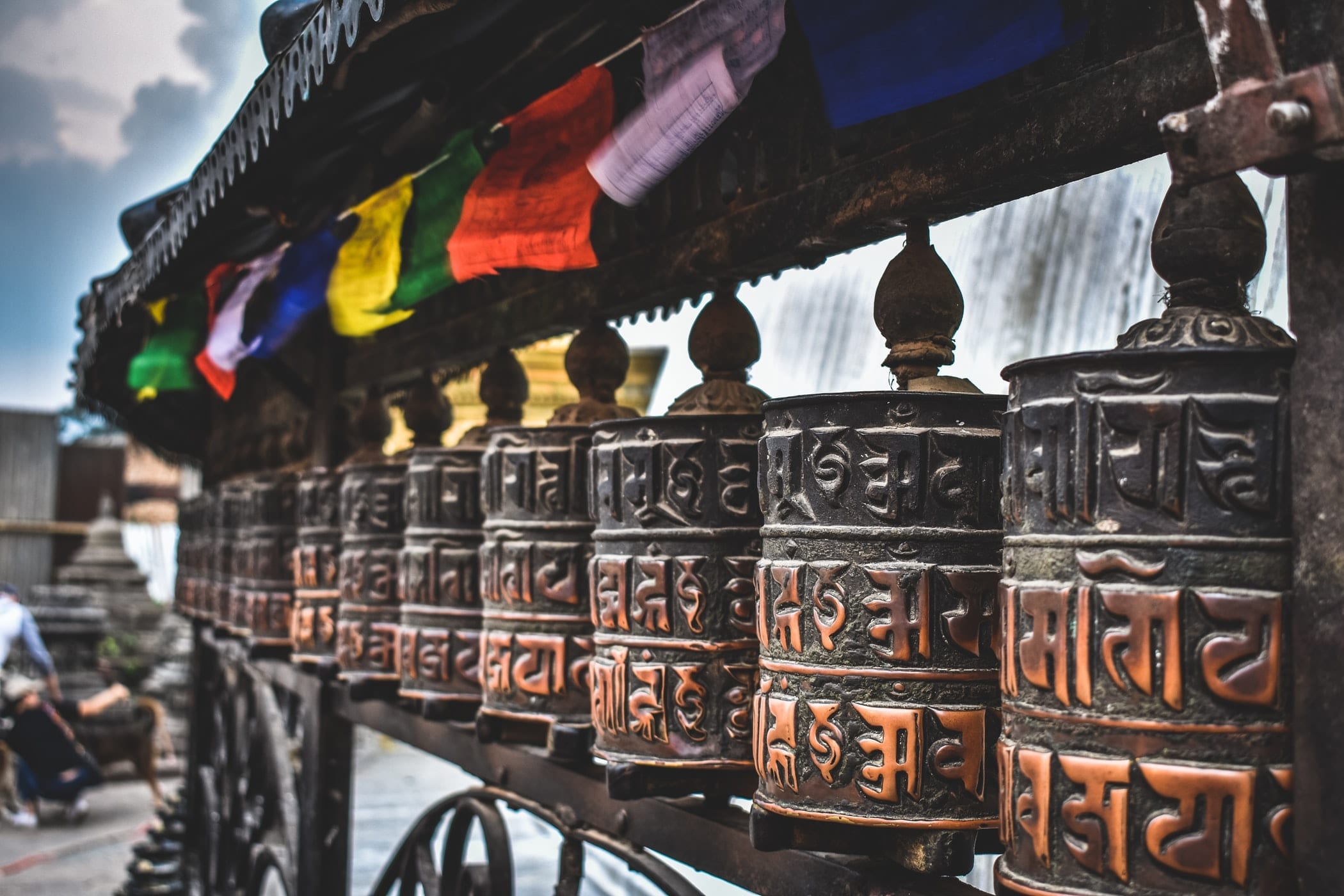
Nepal is a small country with the highest mountain on Earth, the birthplace of the Buddha, the only national flag that isn’t a rectangle, and a calendar more than 56 years ahead of ours. Here are 16 facts about Nepal, from Everest to the living goddess of Kathmandu.
Nepal at a glance
Capital: Kathmandu
Population: 29.2 million (2021 census)
Official language: Nepali
Currency: Nepalese rupee
Borders: China to the north and India to the east, south and west
1It is home to the highest mountain on Earth.
Mount Everest stands on the border between Nepal and Tibet (China). In 2020 the two countries jointly announced its official height as 8,848.86 metres (29,031.7 feet). In Nepal it is called Sagarmatha, meaning “forehead of the sky”.
2Eight of the world’s 14 highest peaks are there.
Only 14 mountains on Earth rise above 8,000 metres, and eight of them, including Everest, Kangchenjunga, Lhotse and Annapurna, lie wholly or partly in Nepal.
3It rises from near sea level to the top of the world.
Nepal’s lowest point, in the southern plains known as the Terai, is only about 60 metres above sea level. Less than 200 km to the north is the summit of Everest, which gives Nepal one of the most dramatic changes of height of any country.
4Its flag is the only one that isn’t a rectangle.
Nepal’s flag is made of two stacked red triangles, or pennants, edged in blue, with a white moon in the top one and a white sun in the bottom. The two peaks are often said to represent the Himalayas, or the country’s two main religions, Hinduism and Buddhism. Its constitution even includes precise instructions for drawing it.

5The Buddha was born there.
Siddhartha Gautama, who became the Buddha, was born at Lumbini in southern Nepal, probably in the 6th or 5th century BC. Lumbini is now a UNESCO World Heritage Site and a place of pilgrimage for Buddhists from all over the world.
6It was never colonised.
Unlike neighbouring India, Nepal never came under European rule. It lost territory to Britain in the Anglo-Nepalese War of 1814 to 1816 but remained independent, and was closed to most foreigners until the 1950s.
7Gurkhas have served in the British Army for more than 200 years.
The British were so impressed by Nepalese soldiers during that war that they began recruiting them in 1815. Gurkha regiments have fought for Britain ever since, and their motto is “Better to die than be a coward”.
8It became a republic in 2008.
Nepal was a Hindu kingdom for 240 years. In 2001, Crown Prince Dipendra shot dead King Birendra and other members of the royal family at a palace dinner, and after years of civil war and protests the monarchy was abolished in 2008.
9Its calendar is more than 56 years ahead.
Nepal’s official calendar, the Bikram Sambat, runs about 56 years and 8 months ahead of the Western one, and its New Year falls in mid-April. That means most of 2026 is the year 2083 in Nepal.
10Its clocks are set 45 minutes off the hour.
Nepal Time is 5 hours and 45 minutes ahead of GMT, one of only a few time zones in the world that are offset by 45 minutes. It is set by the meridian of Mount Gauri Shankar, east of Kathmandu.
11Kathmandu has seven World Heritage monuments.
The Kathmandu Valley World Heritage Site covers seven groups of monuments, including the old royal squares of Kathmandu, Patan and Bhaktapur, the great stupas of Swayambhunath and Boudhanath, and the Hindu temple of Pashupatinath. Many were damaged in the 2015 Gorkha earthquake, which killed nearly 9,000 people, and have since been rebuilt.

12A young girl is worshipped as a living goddess.
In Kathmandu, a girl from the Newar community is chosen to be the Kumari, believed to be the living form of the goddess Taleju. She lives in a palace in Durbar Square and is worshipped until she reaches puberty, when a new Kumari is chosen.
13A Nepalese Sherpa was on the first Everest summit.
On 29 May 1953, Tenzing Norgay and the New Zealander Edmund Hillary became the first people known to reach the top of Everest. The Sherpa people of the Khumbu region are still the backbone of almost every Everest expedition.
14Its tigers have made a comeback.
Nepal’s national parks, such as Chitwan and Bardia, are home to Bengal tigers, greater one-horned rhinos, sloth bears and gharials. Tiger numbers there rose from about 121 in 2009 to 355 in 2022, close to three times as many. Higher up, domestic yaks carry loads in the mountains.

15More than 120 languages are spoken there.
Nepali is the official language, but the 2021 census recorded 124 languages spoken as mother tongues, including Maithili, Bhojpuri, Tharu, Tamang and Newari. English is widely used in tourism and business, although it is not an official language.
16Its national dish is eaten twice a day.
Dal bhat, rice with lentil soup, usually served with vegetable curry and pickles, is eaten by many Nepalis twice a day. Trekkers have a saying: “Dal bhat power, 24 hour”. Momos, steamed dumplings, are the country’s favourite snack.

FAQs about Nepal
What is Nepal famous for?
Mount Everest and the Himalayas, trekking, the birthplace of the Buddha at Lumbini, the temples of the Kathmandu Valley, and its Gurkha soldiers.
Is Nepal part of India?
No. Nepal is an independent country. It shares long borders and close cultural ties with India, and Indian and Nepali citizens can cross the border without a visa.
What language do they speak in Nepal?
Nepali is the official language, and more than 120 other languages are spoken as mother tongues. English is widely understood in tourist areas.
What is the main religion in Nepal?
Hinduism, followed by around 81% of the population, with Buddhism the second-largest religion. The two often share the same festivals and holy sites.
Sources and further reading
Explore more: more facts about Kathmandu.
Do you know any fun facts about Nepal? Share them in the comments below!
Spotted something wrong? Suggest a correction
We check every suggestion and update articles when facts change. Thank you for helping keep facts.uk accurate.
Leave a Reply