
The First World War was fought from 28 July 1914 to 11 November 1918, when an armistice ended the fighting. The Allies, led by Britain and its empire, France and Russia, and later joined by Italy and the United States, fought the Central Powers: Germany, Austria-Hungary, the Ottoman Empire and Bulgaria. Around 9 million soldiers were killed, and estimates of all deaths, including civilians, range from about 15 to 22 million.
People at the time called it the Great War, and many hoped it would be “the war to end all wars”. Here are the facts behind it, from the shocking to the strange.
WW1 at a glance
Started: 28 July 1914, when Austria-Hungary declared war on Serbia
Britain joined: 4 August 1914
Fighting ended: 11am on 11 November 1918 (the Armistice)
Peace treaty: Treaty of Versailles, signed 28 June 1919
Soldiers mobilised: around 65 to 70 million
Military deaths: around 9 million
1It began with a wrong turn in Sarajevo
On 28 June 1914, Archduke Franz Ferdinand, heir to the throne of Austria-Hungary, was visiting Sarajevo. A bomb attack on his car that morning failed. Later, his driver took a wrong turn and stopped to reverse, right beside a young Bosnian Serb named Gavrilo Princip, who shot the Archduke and his wife Sophie. Within six weeks, Europe was at war.
2The Archduke’s number plate seemed to predict the Armistice
The car Franz Ferdinand was riding in carried the registration A III 118. Years later, people noticed it could be read as “Armistice 11-11-18”, the date the war ended. It is pure coincidence, but a remarkable one.

3Tanks were called “tanks” to keep them secret
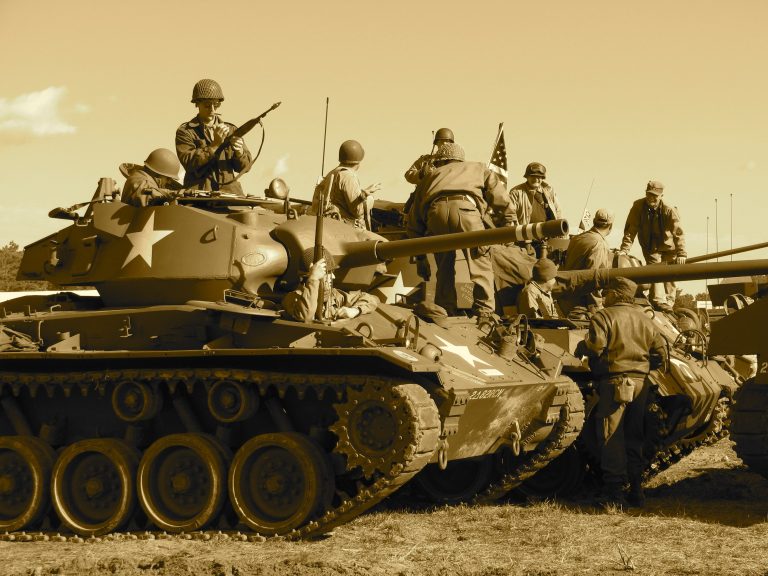
When Britain developed its first armoured fighting vehicles, workers were told they were building water carriers for the desert. The name “tank” stuck. They were first used in battle at Flers-Courcelette, during the Battle of the Somme, on 15 September 1916.
4Tanks came in “male” and “female” versions
Early British tanks were called “male” if they carried cannons and “female” if they were armed only with machine guns. Some later tanks carried one of each and were nicknamed “hermaphrodites”.
5Enemies played football on Christmas Day 1914
In the first Christmas of the war, soldiers in some parts of the Western Front stopped fighting on their own accord. British and German troops met in no man’s land, swapped food and souvenirs, sang carols and buried their dead. In a few places, they played football. Commanders made sure it did not happen again on the same scale.
6Poison gas was used on a large scale from 1915
On 22 April 1915, at the Second Battle of Ypres in Belgium, German troops released chlorine gas from thousands of cylinders. Both sides went on to use gas, including phosgene and mustard gas. Gas masks became part of every soldier’s kit.
7The first day of the Somme was the worst in British Army history
On 1 July 1916, the opening day of the Battle of the Somme, the British Army suffered 57,470 casualties, including 19,240 men killed. No day before or since has been as deadly for the British Army.
8An explosion in Belgium was heard in London
Before the Battle of Messines on 7 June 1917, British tunnellers packed huge mines under German positions. When 19 of them were detonated at once, the blast was one of the largest man-made explosions in history up to that time. It was reportedly heard in London, about 140 miles away.

9Munitions workers turned yellow
Hundreds of thousands of women worked in munitions factories, and those filling shells with TNT were exposed to toxic chemicals that turned their skin yellow. They were nicknamed “canaries”. The work was dangerous: some died from poisoning, and others were killed in factory explosions.
10Twelve million letters a week reached the front
Keeping soldiers in touch with home was seen as vital for morale. At its peak, the British Army Postal Service was delivering around 12 million letters a week to the Western Front, sorted at a huge depot in Regent’s Park in London. A letter from Britain often reached the trenches in two or three days.
11A 12-year-old boy fought at the Somme
Thousands of boys lied about their age to join up. Sidney Lewis from London enlisted at just 12 and fought at the Somme in 1916 aged 13, before his mother sent his birth certificate to the War Office and he was sent home. He is believed to have been the youngest British soldier of the war.
12The first blood bank was set up on the battlefield
In 1917 a US Army doctor, Oswald Robertson, collected and stored blood behind the lines in France so it was ready for wounded soldiers. It is regarded as the first blood bank, and the idea saved countless lives in later wars and in hospitals around the world.
13The war created modern plastic surgery
Harold Gillies, a New Zealand-born surgeon, set up a hospital at Sidcup in Kent to rebuild the faces of soldiers with terrible injuries. He developed new techniques for moving skin and tissue that earned him the title “the father of modern plastic surgery”.
14Doctor Dolittle was born in the trenches
Hugh Lofting, serving with the Irish Guards, did not want to write to his children about the horrors around him. Instead, he sent them illustrated stories about a doctor who could talk to animals. After the war they became the Doctor Dolittle books.
15America turned against all things German
When the United States joined the war, German, then widely spoken in America, was banned or dropped from many schools. German words were swapped out too: sauerkraut was sold as “liberty cabbage”, and German measles was even called “liberty measles”.
16Over 12,000 Native Americans served without being US citizens
More than 12,000 Native Americans served in the US forces in the First World War, many as volunteers, at a time when most were not US citizens. Their service helped lead to the Indian Citizenship Act of 1924, which made all Native Americans born in the US citizens.

17The US President was elected for keeping America out of the war
Woodrow Wilson won re-election in November 1916 with the slogan “He kept us out of war”. Five months later, in April 1917, after German submarines sank American ships and the Zimmermann Telegram revealed a German plot to bring Mexico into the war, he asked Congress to declare war on Germany.
18The flu that followed killed even more people
The 1918 flu pandemic spread rapidly through crowded army camps and troopships. It is often called “Spanish flu” only because Spain, which was neutral, reported on it freely while countries at war censored the news. It killed more people worldwide than the war itself.
19The poppy came from a poem
Red poppies grew in the churned-up fields of Flanders. Canadian doctor John McCrae wrote the poem “In Flanders Fields” in 1915, and the poppy became the symbol of remembrance. The Royal British Legion held its first Poppy Appeal in 1921.
20An unknown soldier lies among kings
On 11 November 1920, the body of an unidentified British soldier, brought back from the battlefields of France, was buried in Westminster Abbey. The Tomb of the Unknown Warrior represents everyone who died with no known grave. It is the only tomb in the Abbey that visitors are not allowed to walk on.
FAQs about the First World War
What started World War 1?
The assassination of Archduke Franz Ferdinand of Austria-Hungary in Sarajevo on 28 June 1914 set off a chain of alliances and declarations of war. Deeper causes included rivalry between the great powers, an arms race and competition for empire.
When did WW1 start and end?
It began on 28 July 1914 and the fighting ended with the Armistice at 11am on 11 November 1918. The Treaty of Versailles was signed on 28 June 1919.
Who fought in WW1?
The Allies, including Britain and its empire, France, Russia, Italy, Japan and later the United States, against the Central Powers: Germany, Austria-Hungary, the Ottoman Empire and Bulgaria.
How many people died in WW1?
Around 9 million soldiers were killed. Including civilians, estimates of total deaths range from about 15 to 22 million.
Why was it called the Great War?
Because nothing on its scale had ever been seen before. It was only called the First World War after the Second World War began in 1939.
Who was the last surviving WW1 veteran?
Harry Patch, the last British soldier to have fought in the trenches, died in 2009 aged 111. The last known veteran of the war, Florence Green, who served with the Women’s Royal Air Force, died in 2012.
Sources and further reading
- Imperial War Museums: First World War
- Imperial War Museums: the dangers of working in a munitions factory
- Westminster Abbey: the Unknown Warrior
Explore more: facts about the 1900s, facts about the British Empire and facts about London.
Do you know any fun facts about WW1? Share them in the comments below!
Spotted something wrong? Suggest a correction
We check every suggestion and update articles when facts change. Thank you for helping keep facts.uk accurate.
Leave a Reply