
Scuba diving lets you breathe underwater and explore a world most people only see on television. It is also full of surprises, from colours that vanish as you go down to the hand signal that means something quite different underwater. Here are 20 facts about scuba diving.
1SCUBA is an acronym.
It stands for Self-Contained Underwater Breathing Apparatus. The term was coined in 1952 by Christian Lambertsen, an American army doctor who designed breathing equipment for military divers.
2The Aqua-Lung made diving popular.
In 1943, the French naval officer Jacques Cousteau and the engineer Émile Gagnan tested the Aqua-Lung, which supplied air from a tank whenever the diver breathed in. Modern diving regulators still work on the same idea.

3Divers breathe air, not pure oxygen.
A standard scuba tank is filled with ordinary compressed air, about 21% oxygen and 78% nitrogen. Breathing pure oxygen at depth would be dangerous, because oxygen becomes toxic under pressure.
4The pressure doubles in just 10 metres.
At the surface you are under one atmosphere of pressure, from the weight of the air above you. Every 10 metres of seawater adds another atmosphere, so at 10 metres the pressure is double and the air in a diver’s lungs is squeezed to half its size.
5The golden rule is never hold your breath.
As a diver rises, the air in their lungs expands. Holding your breath while ascending can over-stretch and damage the lungs, so divers are taught to breathe normally at all times.
6Ear problems are the most common diving injury.
Divers have to “equalise” the pressure in their ears as they go down, usually by gently pinching the nose and blowing. Ear injuries caused by pressure, called barotrauma, are the most common problem divers report.

7Colours disappear as you go down.
Water absorbs light, starting with red. Red is the first colour to fade within the first few metres, followed by orange and yellow, so deeper scenes look blue and green. Divers carry torches to bring the colours back.
8Blood looks green at depth.
Because the red light has been filtered out, a small cut on a diver at 20 metres or so can look green or even black, until it is lit with a torch.
9Deep air can make you feel drunk.
Breathing nitrogen under pressure causes nitrogen narcosis, which can feel like being tipsy, from below about 30 metres. Divers sometimes call it the “martini effect”. It wears off as soon as the diver goes shallower.

10“The bends” got their name from bridge builders.
Decompression sickness happens when nitrogen absorbed by the body forms bubbles if a diver comes up too quickly. It was first widely seen in workers building bridge foundations in pressurised chambers called caissons in the 1800s, who were left stooped and bent over with pain.
11Divers come up slowly and stop on the way.
To avoid the bends, divers rise slowly, usually no faster than 9 to 18 metres a minute depending on their training, and make a “safety stop” of three minutes at about 5 metres before reaching the surface.
12Beginners can dive to 18 metres.
The most popular first course, the Open Water Diver, trains people to dive to 18 metres. With more training, recreational divers can go to 30 metres and then to a limit of 40 metres. Going deeper is technical diving, which needs special gases and training.

13Nitrox lets divers stay down longer.
Nitrox is air with extra oxygen and less nitrogen. Divers absorb less nitrogen breathing it, so they can stay longer at moderate depths, but the extra oxygen means they must not go as deep.
14Thumbs up means “go up”.
Divers talk with hand signals. A thumbs up does not mean “all good” underwater: it means “let’s go up”. To say “OK”, divers make a circle with the thumb and first finger.

15Sound travels about four times faster underwater.
Sound moves through water at roughly 1,500 metres a second, about four times faster than through air. That makes it very hard to tell which direction a noise, such as a boat engine, is coming from.
16Water steals your body heat.
Water draws heat away from the body about 25 times faster than air at the same temperature. That is why divers wear wetsuits or drysuits, even in warm seas.

17Divers spit in their masks.
Rubbing a little saliva on the inside of the glass and rinsing it stops a mask from fogging up. Divers also use baby shampoo or special anti-fog gels.
18Grenada has an underwater sculpture park.
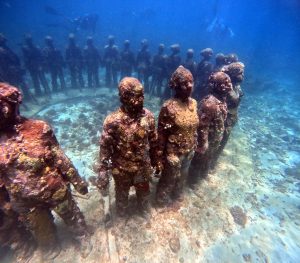
In 2006, the British artist Jason deCaires Taylor began sinking sculptures in Molinere Bay, Grenada, creating the world’s first underwater sculpture park. His best-known piece there, Vicissitudes, is a ring of children holding hands, and the statues are slowly being covered in coral.
19One of the Caribbean’s biggest wrecks is in Grenada too.
The Italian liner Bianca C caught fire after an engine room explosion off St George’s in October 1961 and sank about 2 kilometres from Grand Anse beach. The 180-metre ship lies in about 50 metres of water, with its upper decks at around 30 metres, making it one of the largest wrecks recreational divers can visit.
20The deepest scuba dive went below 330 metres.
Guinness World Records lists a dive to 332.35 metres by the Egyptian diver Ahmed Gabr in the Red Sea in 2014. The trip down took minutes, but coming back up safely took many hours. The record has been questioned by some divers, but Guinness has kept it.

FAQs about scuba diving
Do you need to be able to swim to scuba dive?
Yes, for a full certification. Most courses ask you to swim 200 metres (or 300 metres with a mask, fins and snorkel) and float or tread water for 10 minutes. Non-swimmers can still try a supervised experience dive in a pool.
How old do you have to be to learn to dive?
Children can take a junior open water course from the age of 10, with depth limits. Many dive centres offer pool sessions for children from 8.
Is scuba diving dangerous?
Serious accidents are rare for trained divers who follow the rules, dive within their limits and check their equipment. Most problems come from diving beyond your training or experience.
Sources and further reading
- Divers Alert Network (DAN)
- PADI
- Scuba Diving: the history of Grenada’s Bianca C
- Live Science: the deepest scuba dive
Explore more: facts about oxygen, facts about sharks, facts about the Mariana Trench and facts about coral reefs.
Do you know any fun facts about scuba diving? Share them in the comments below!
Spotted something wrong? Suggest a correction
We check every suggestion and update articles when facts change. Thank you for helping keep facts.uk accurate.
3 responses to “20 Facts About Scuba Diving: Pressure, Colour, Records and Wrecks”
-
I love this.
-
The author might want to take another look at number 4 and correct the error. Oxygen does become toxic at dept however, it’s the nitrogen in the compressed air that causes “nitrogen” narcosis.
-
Thank you for pointing this out! Now fixed with an extra fact all about nitrogen narcosis.
-



Leave a Reply