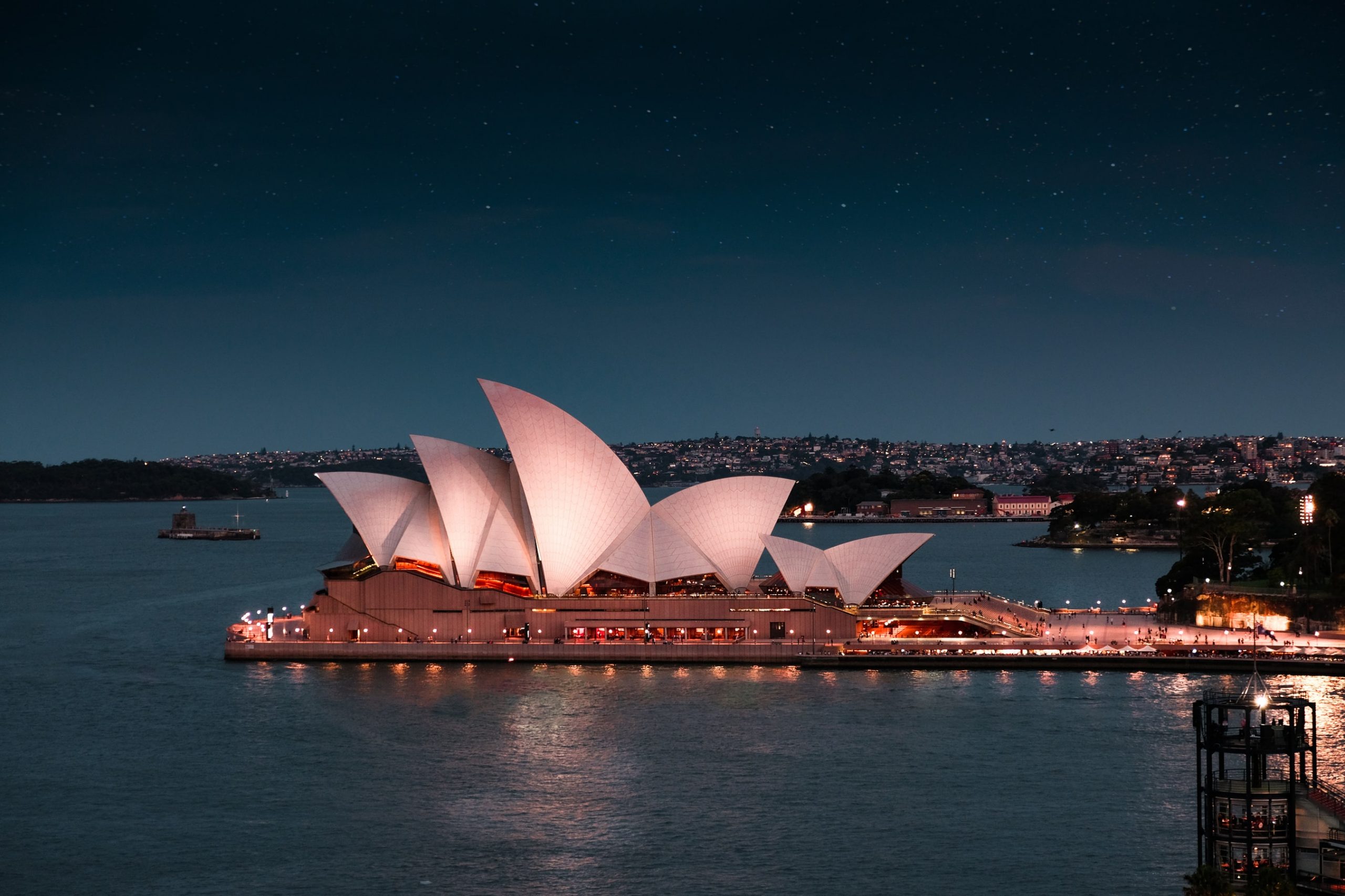
The Sydney Opera House took 14 years to build instead of four, cost 14 times its budget, and opened without its architect, who had quit and never came back to see it. Today it is one of the most famous buildings in the world. Here are 15 facts about the Sydney Opera House, from its million roof tiles to the bodybuilding contest held in its Concert Hall.
Sydney Opera House at a glance
Where: Bennelong Point, Sydney Harbour, New South Wales, Australia
Architect: Jørn Utzon (Denmark)
Built: 1959 to 1973
Opened: 20 October 1973, by Queen Elizabeth II
Cost: AU$102 million, against an original estimate of AU$7 million
1It was opened by the Queen in 1973.
Queen Elizabeth II officially opened the Sydney Opera House on 20 October 1973, with fireworks over the harbour and a performance of Beethoven’s Ninth Symphony. She returned three more times, most recently in 2006.

2Its design was chosen in an international competition.
In 1957, a 38-year-old Danish architect, Jørn Utzon, won a competition that attracted 233 entries from 32 countries. According to a popular story, his sketches had been put aside until the American architect Eero Saarinen, one of the judges, picked them out.
3It went massively over budget.
The building was expected to cost AU$7 million and take four years. In the end it took 14 years and cost AU$102 million. Most of the money was raised through a special state lottery, so the building was paid off by 1975.
4Nobody knew how to build the roof at first.
Utzon’s soaring “sails” were so unusual that engineers spent years working out how to build them. In 1961 he found the answer: every shell is cut from the surface of the same imaginary sphere, so the pieces could be made from standard, repeatable parts.
5The roof is covered in more than a million tiles.
The sails are covered in 1,056,006 glazed white and cream tiles made by Höganäs in Sweden. They were designed to be self-cleaning, and from a distance they look pure white, although up close they form a chevron pattern.
6Its architect never saw it finished.
After disputes with the New South Wales government over costs and payments, Utzon resigned in 1966 and left Australia. The interiors were completed by a team of Australian architects led by Peter Hall, and Utzon never returned to see the finished building. He died in 2008.
7He was later brought back to design one room.
In 1999, the Opera House invited Utzon to set out design principles for its future. The Utzon Room, which he redesigned with a large tapestry of his own, reopened in 2004 and is the only interior that matches his original vision.
8Its architect won architecture’s top prize.
In 2003, Utzon was awarded the Pritzker Prize, often called the Nobel Prize of architecture, with the Opera House cited as his masterpiece.
9It is one of the youngest World Heritage Sites.
The Sydney Opera House was added to UNESCO’s World Heritage List in 2007, only 34 years after it opened, while its architect was still alive. UNESCO called it “a great architectural work of the 20th century”.

10The first performance was a war epic.
The first public performance, on 28 September 1973, was Prokofiev’s opera War and Peace, staged by the Australian Opera, a few weeks before the official opening.
11It has one of the world’s great organs.
The Grand Organ in the Concert Hall has 10,154 pipes and took ten years to build. It is often described as the largest mechanical-action pipe organ in the world.
12Arnold Schwarzenegger won a title there.
In 1980, Arnold Schwarzenegger came out of retirement to win the Mr Olympia bodybuilding contest, held in the Opera House’s Concert Hall. It was his seventh and final Mr Olympia title.
13Most visitors don’t come to see a show.
More than 10 million people visit the Sydney Opera House each year, but only a small share of them buy tickets for one of its more than 1,500 performances a year. The rest come to take photos, take a tour or eat and drink on the harbour front.
14It stands on a site named after an Aboriginal man.
Bennelong Point is named after Woollarawarre Bennelong, a Wangal man who acted as a go-between with the first British settlers. Before the Opera House, the site was a tram depot built to look like a fort. Since 2017, the sails have been lit up every evening with Badu Gili, a projection of First Nations art.

15It is bigger than it looks.
The building is about 183 metres long and 120 metres wide at its widest point, and its highest sail rises 67 metres above sea level. It rests on 580 concrete piers sunk up to 25 metres below sea level, and contains around 1,000 rooms, including seven performance venues.
FAQs about Sydney Opera House
Who designed the Sydney Opera House?
The Danish architect Jørn Utzon, who won an international competition in 1957. The interiors were finished by an Australian team after he resigned in 1966.
How long did it take to build the Sydney Opera House?
14 years, from 1959 to 1973, around ten years longer than planned.
Can you go inside the Sydney Opera House?
Yes. Guided tours run every day, and you can see a performance, from opera and ballet to comedy and concerts. The forecourt, steps and bars around it are open to everyone.
Why is the Sydney Opera House shaped like sails?
Utzon’s shells are often compared to sails on the harbour, although he also drew on other ideas, including clouds, birds’ wings and, according to one story, the segments of a peeled orange.
Sources and further reading
Explore more: more facts about Sydney.
Do you know any fun facts about the Sydney Opera House? Share them in the comments below!
Spotted something wrong? Suggest a correction
We check every suggestion and update articles when facts change. Thank you for helping keep facts.uk accurate.
Leave a Reply