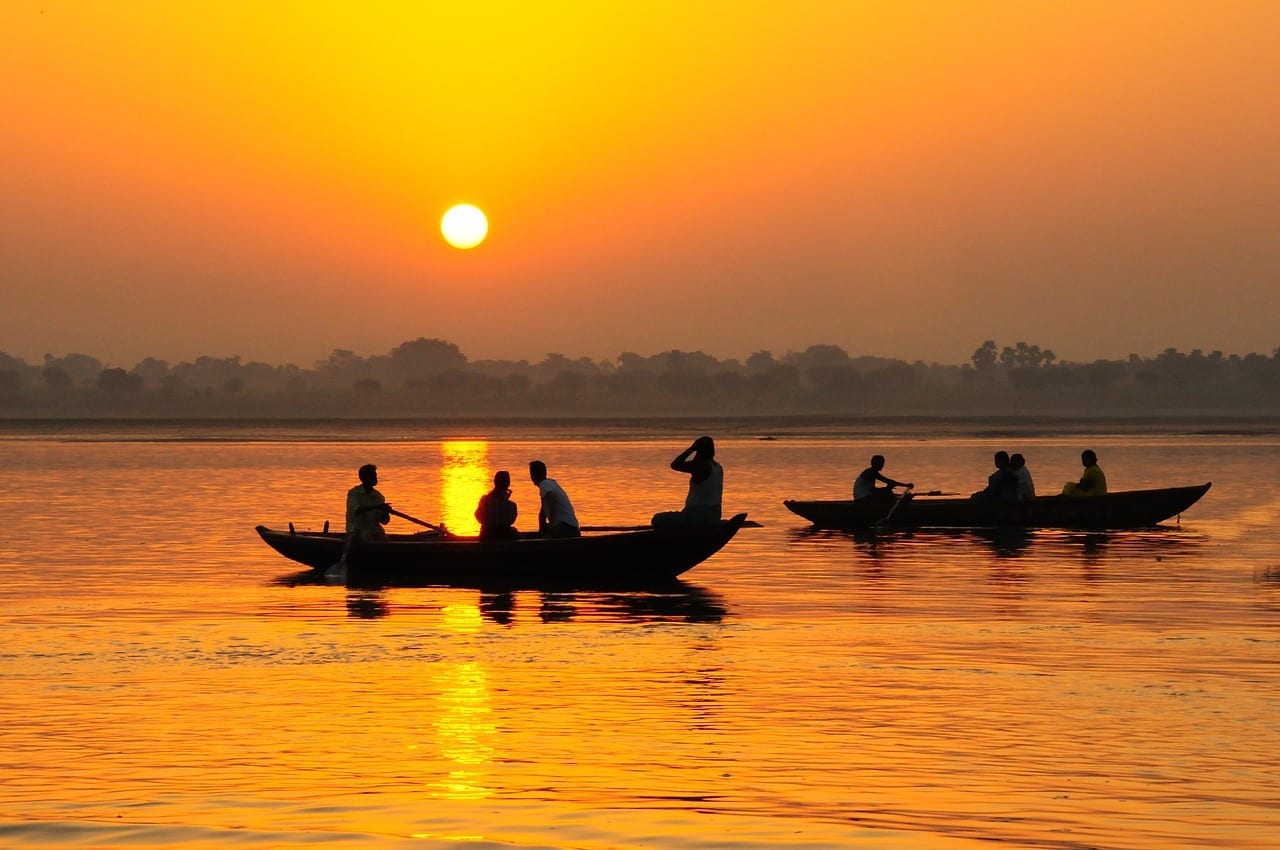
The Ganges is India’s holiest river, a goddess to around a billion Hindus, and a lifeline for hundreds of millions of people who live along its banks. It is home to rare river dolphins and sharks, hosts the largest religious gathering on Earth, and is also one of the most polluted rivers in the world. Here are 15 facts about the Ganges.
The Ganges at a glance
Length: about 2,525 km (1,569 miles)
Source: the Gangotri Glacier in the Himalayas, in the Indian state of Uttarakhand
Countries: India and Bangladesh
Ends in: the Bay of Bengal, via the world’s largest river delta
Also called: Ganga in India, Padma in Bangladesh
1The river is a goddess.
In Hinduism the Ganges is the goddess Ganga, and the river is known in India by her name. According to legend, King Bhagiratha prayed for Ganga to come down from heaven to purify the ashes of his ancestors, and Shiva caught her in his hair to soften her fall to Earth.
2It begins at an ice cave in the Himalayas.
The river’s main source stream, the Bhagirathi, flows out of an ice cave called Gaumukh (“cow’s mouth”) at the foot of the Gangotri Glacier, almost 3,900 metres (about 12,800 feet) above sea level. It only takes the name Ganges at Devprayag, where it meets the Alaknanda River.
3It runs for over 2,500 km.
From the Himalayas the Ganges flows south and east across the plains of northern India and into Bangladesh, a journey of about 2,525 km (1,569 miles). Its basin covers about a quarter of India’s land area.
4Hundreds of millions of people depend on it.
The Ganges basin is one of the most densely populated places on Earth, home to around 400 million people. Its water is used for drinking, farming, fishing and bathing, and it waters some of India’s most important farmland.
5It ends in the world’s largest delta.
The Ganges joins the Brahmaputra and Meghna in Bangladesh to form the Ganges-Brahmaputra delta, the largest river delta in the world. Part of it is the Sundarbans, the largest mangrove forest on Earth and one of the last strongholds of the Bengal tiger.
6Bathing in it is believed to wash away sins.
Millions of Hindus bathe in the Ganges every year, believing its water cleanses them of sin. Many families keep a bottle of Ganges water (Gangajal) at home for religious rituals.
7It hosts the biggest gathering of people on Earth.
The Kumbh Mela festival brings pilgrims to bathe where the Ganges meets the Yamuna at Prayagraj. Authorities estimated that the 2025 Maha Kumbh Mela, held over six weeks, drew more than 600 million visits, the largest religious gathering in history.
8Varanasi is its holiest city.
Varanasi, one of the oldest continuously inhabited cities in the world, lines the river with stone steps called ghats. Hindus believe that being cremated there and having one’s ashes scattered in the Ganges can free the soul from the cycle of rebirth, and funeral pyres burn day and night at Manikarnika Ghat.
9India’s national aquatic animal lives in it.
The Ganges river dolphin is almost blind and finds its food using echolocation. It is endangered, and in 2009 India made it the country’s national aquatic animal to help protect it.
10There are sharks in the Ganges.
The Ganges shark is a rare, critically endangered shark that lives in the river’s lower reaches and estuary. It is so rarely seen that scientists know very little about it.
11Gharials still hunt its waters.
The gharial, a long, thin-snouted crocodilian that eats almost nothing but fish, once lived throughout the river system. It is now critically endangered, surviving in a few protected stretches of the Ganges’ tributaries.

12Its water contains unusual numbers of bacteria-killing viruses.
Scientists have found that the Ganges carries high levels of bacteriophages, viruses that attack bacteria, which may help explain old beliefs that its water stays fresh. They don’t make the water safe, though: it still carries disease-causing bacteria.
13It is also one of the most polluted rivers in the world.
Sewage from cities along its banks, industrial waste and partly cremated remains have made parts of the Ganges dangerously polluted. In 2014 India launched Namami Gange, a large government programme to clean it up.
14Many great rivers feed it.
Major tributaries including the Yamuna, Ghaghara, Gandak and Kosi flow into the Ganges. The Yamuna, which flows past Delhi and the Taj Mahal, is the longest of them.
15Its glaciers are shrinking.
The Gangotri Glacier has been retreating for more than a century and has pulled back by well over a kilometre since measurements began. Scientists warn that warming in the Himalayas could change how much water the river carries in the decades ahead.
FAQs about the Ganges
Why is the Ganges so important?
It is the most sacred river in Hinduism, worshipped as the goddess Ganga, and it supplies water to hundreds of millions of people in India and Bangladesh.
How long is the River Ganges?
About 2,525 km (1,569 miles), from the Gangotri Glacier in the Himalayas to the Bay of Bengal.
Is it safe to swim in the Ganges?
Millions of people bathe in it for religious reasons, but in many places the water is heavily polluted with sewage and bacteria, so it is not considered safe for swimming or drinking without treatment.
What animals live in the Ganges?
Around 140 species of fish, the endangered Ganges river dolphin, the gharial, freshwater turtles, and the rare Ganges shark.
Sources and further reading
Do you know any fun facts about the Ganges? Share them in the comments below!
Spotted something wrong? Suggest a correction
We check every suggestion and update articles when facts change. Thank you for helping keep facts.uk accurate.
Leave a Reply